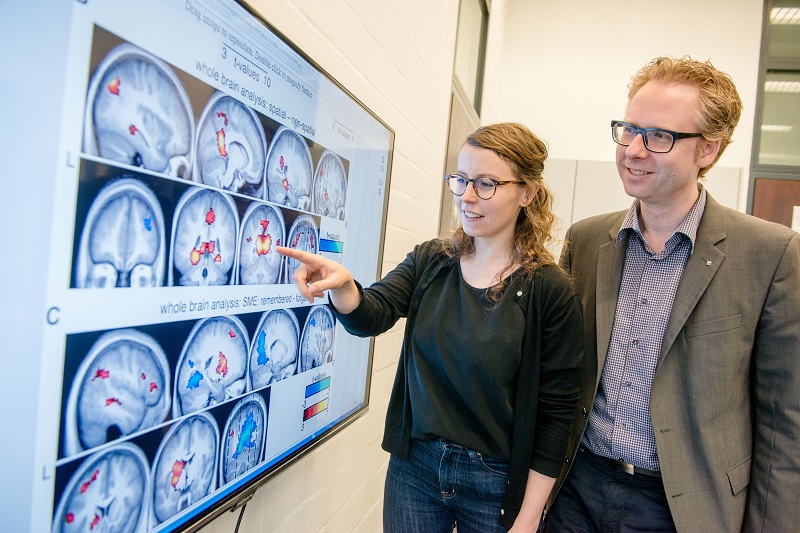
Im ersten Förderjahr werden fMRT-Datensätze ausgewertet, die im Rahmen der FOR 1581 erhoben worden sind, einschließlich der für das Kleinhirn optimierten Normalisierung. Im ersten Förderjahr erfolgt weiterhin die Homogenisierung der geplanten Resting State fMRT und DTI Aufnahmen an den drei 3T MRT-Geräten in Essen und Bochum. Ab dem zweiten Förderjahr erfolgt die geplante Meta-Analyse von im Rahmen des SFB 1280 erhobenen MRT Datensätzen mit Fokus auf Konnektivitätsanalysen im Extinktionsnetzwerk. State-of-the-art- Analyseverfahren für strukturelle und funktionelle Konnektivitätsanalysen sowie optimierte Normalisierungsprotokolle des Kleinhirns werden über den gesamten Förderzeitraum für Teilprojekte zugänglich gemacht.
Hypothesen des Projekts F02:
Bouyeure A, Pacheco D, Jacob G, Kobelt M, Fellner MC, Rose J, Axmacher N (2025) Distinct representational properties of cues and contexts shape fear learning and extinction. Elife:14:RP105126. https://doi.org/10.7554/eLife.105126
Englert R, Kincses B, Kotikalapudi R, Gallitto G, Li J, Hoffschlag K, Woo C-W, Wager TD, Timmann D, Bingel U, Spisák T (2024) Connectome-Based Attractor Dynamics Underlie Brain Activity in Rest, Task, and Disease. eLife. 13: RP98725. https://doi.org/10.7554/eLife.98725
Ernst TM, Brol AE, Gratz M, Ritter C, Bingel U, Schlamann M, Maderwald S, Quick HH, Merz CJ, Timmann D (2019) The cerebellum is involved in processing of predictions and prediction errors in a fear conditioning paradigm. Elife. 8: e46831. https://doi.org/10.7554/eLife.46831
Genç E, Metzen D, Fraenz C, Schlüter C, Voelkle MC, Arning L, Streit F, Nguyen HP, Güntürkün O, Ocklenburg S, Kumsta R (2023) Structural architecture and brain network efficiency link polygenic scores to intelligence. Hum Brain Mapp. 44(8): 3359-3376. https://doi.org/10.1002/hbm.26286
Kincses B, Forkmann K, Schlitt F, Jan Pawlik R, Schmidt K, Timmann D, Elsenbruch S, Wiech K, Bingel U, Spisák T (2024) An externally validated resting-state brain connectivity signature of pain-related learning. Commun Biol. 7(1): 875. https://doi.org/10.1038/s42003-024-06574-y
Labrenz F, Spisák T, Ernst TM, Gomes CA, Quick HH, Axmacher N, Elsenbruch S, Timmann D (2022) Temporal dynamics of fMRI signal changes during conditioned interoceptive pain-related fear and safety acquisition and extinction. Behav Brain Res. 427: 113868. https://doi.org/10.1016/j.bbr.2022.113868
Nio E, Pais Pereira P, Diekmann N, Petrenko M, Doubliez A, Ernst TM, Batsikadze G, Maderwald S, Deuschl C, Üngör M, Cheng S, Merz CJ, Quick HH, Timmann D (2025) Human cerebellum and ventral tegmental area interact during extinction of learned fear. eLife. 14: RP105399. https://doi.org/10.7554/eLife.105399
Pfaffenrot V, Bouyeure A, Gomes CA, Kashyap S, Axmacher N, Norris DG (2025) Characterizing BOLD activation patterns in the human hippocampus with laminar fMRI. bioRxiv. 2024.07.04.602065 https://doi.org/10.1162/imag_a_00532
Schneider Penate JE, Gomes CA, Spisák T, Genç E, Merz CJ, Wolf OT, Quick HH, Elsenbruch S, Engler H, Fraenz C, Metzen D, Ernst TM, Thieme A, Batsikadze G, Hagedorn B, Timmann D, Güntürkün O, Axmacher N, Kumsta R (2025) Polygenic prediction of fear learning is mediated by brain connectivity. medRxiv 2025.03.12.25323754 https://doi.org/10.1101/2025.03.12.25323754
Spisák T, Bingel U, Wager TD (2023) Multivariate BWAS can be replicable with moderate sample sizes. Nature. 615(7951): E4-7. https://doi.org/10.1038/s41586-023-05745-x

As the calendar turns to a new year, millions of people around the world commit to New Year’s resolutions, making promises to use the new year as a fresh beginning and an opportunity for transformation. In 2024, almost three-quarters of the British population set themselves New Year’s resolutions — that’s around 40 million people (or the entire population of Canada). This tradition was particularly strong among younger generations, with 96% of Generation Z (aged 18-27) planning resolutions, compared to just 35% of the Silent Generation (aged 79+).
Most common new years resolutions:
How long do most resolutions normally last before being broken?
What makes resolutions stick?
Oscarsson et al. (2020) conducted research into what makes New Year’s resolutions stick. Biggest success rates depended on how people phrased their goals. Participants who set approach-oriented goals (trying to move toward or maintain a desirable outcome or state) than those with avoidance-oriented goals (trying to move toward or maintain a desirable outcome or state) were significantly more successful (58.9% vs. 47.1%) at sticking to their goals.
The study also investigates the effects of outside support. These participants received monthly follow-ups and emails with information and exercises for coping with hurdles when striving toward personal goals, and were also encouraged to set goals using the SMART technique and to set interim goals. The group that received some support was exclusively and significantly more successful compared to the groups who received a lot of support or no support at all.
Additionally, you might feel more successful if you set goals that are measurable in numbers. While success for a person striving to quit smoking or lose weight could easily be measured in the number of cigarettes smoked or body mass index, the success for a person striving to „take better care of themselves“ could be highly subjective and possibly impossible to measure.
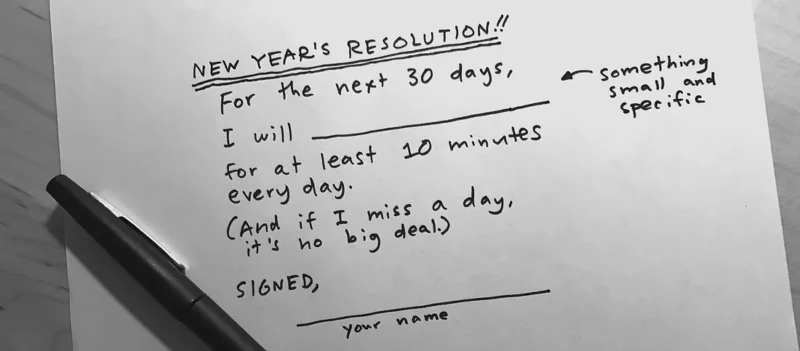
So as we enter 2026, let’s remember to work with our brain’s natural learning system: Frame your goals positively, break them into manageable steps, and celebrate small wins along the way.