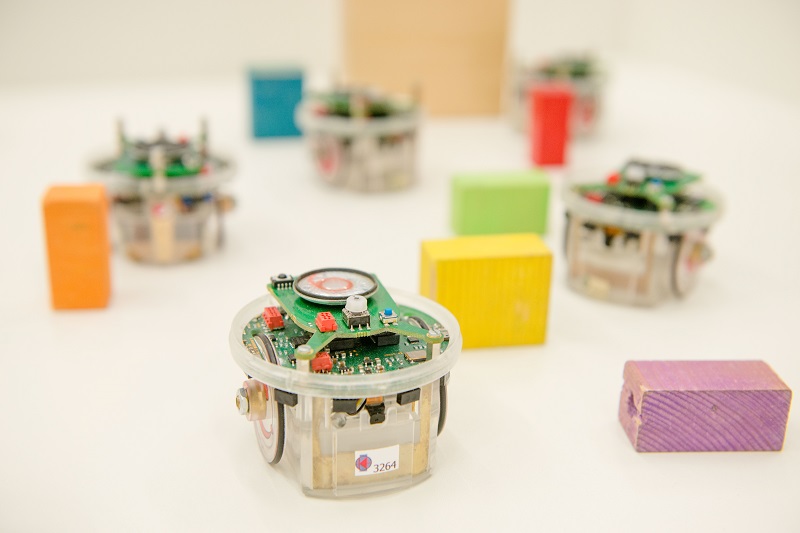
Extinktionslernen ist stark abhängig vom den Kontexten, in denen Akquisition und Extinktion stattfanden, und es ist bekannt, dass der Hippokampus maßgeblich ist für die Kontext-Abhängigkeit. Es fehlt allerdings ein tiefes Verständnis der Lernmechanismen und neuronalen Grundlagen, die zur Entstehung der Kontext-Abhängigkeit führen. In diesem Teilprojekt werden computationale Modellierung und Robotik angewandt, um zu untersuchen, 1. was Lernsignale von kontextuellen Informationen unterscheidet, 2. was Extinktionslernen abhängiger vom Kontext macht als Akquisition und 3. warum der Hippokampus für die Kontext-Abhängigkeit erforderlich ist.
Leitfragen des Projekts A14:
Diekmann N, Vijayabaskaran S, Zeng X, Kappel D, Menezes MC, Cheng S (2023) CoBeL-RL: A neuroscience-oriented simulation framework for complex behavior and learning. Front Neuroinformatics 17:1134405. https://doi.org/10.3389/fninf.2023.1134405
Ghazinouri B, Cheng S (2025) The Cost of Behavioral Flexibility: Reversal Learning Driven by a Spiking Neural Network. In: From Animals to Animats 17 (Brock O, Krichmar J, eds), pp 39–50. Cham: Springer Nature Switzerland. https://doi.org/10.1007/978-3-031-71533-4_23
Kappel D, Cheng S (2025) Global remapping emerges as the mechanism for renewal of context-dependent behavior in a reinforcement learning model. Front Comput Neurosci 18:1462110. https://doi.org/10.3389/fncom.2024.1462110
Menezes M, Zeng X, Cheng S (2025) Revealing the mechanisms underlying latent learning with successor representations. bioRxiv:2025.03.01.640768. https://doi.org/10.1101/2025.03.01.640768
Parra-Barrero E, Vijayabaskaran S, Seabrook E, Wiskott L, Cheng S (2023) A map of spatial navigation for neuroscience. Neurosci Biobehav Rev 152:105200. https://doi.org/10.1016/j.neubiorev.2023.105200
Pusch R, Packheiser J, Azizi AH, Sevincik CS, Rose J, Cheng S, Stüttgen MC, Güntürkün O (2023) Working memory performance is tied to stimulus complexity. Commun Biol 6:1–16. https://doi.org/10.1038/s42003-023-05486-7
Vijayabaskaran S, Cheng S (2022) Navigation task and action space drive the emergence of egocentric and allocentric spatial representations. PLOS Comput Biol 18:e1010320. https://doi.org/10.1371/journal.pcbi.1010320
Vijayabaskaran S, Cheng S (2024) Competition and Integration of Visual and Goal Vector Signals for Spatial Navigation bioRxiv:2024.05.14.594206. https://doi.org/10.1101/2024.05.14.594206
Walther T, Diekmann N, Vijayabaskaran S, Donoso JR, Manahan-Vaughan D, Wiskott L, Cheng S (2021) Contextdependent extinction learning emerging from raw sensory inputs: a reinforcement learning approach. Sci Rep 11:2713. https://doi.org/10.1038/s41598-021-81157-z
Zhao D, Zhang Z, Lu H, Cheng S, Si B, Feng X (2022) Learning Cognitive Map Representations for Navigation by Sensory–Motor Integration. IEEE Trans Cybern 52:508–521. https://doi.org/10.1109/TCYB.2020.2977999

As the calendar turns to a new year, millions of people around the world commit to New Year’s resolutions, making promises to use the new year as a fresh beginning and an opportunity for transformation. In 2024, almost three-quarters of the British population set themselves New Year’s resolutions — that’s around 40 million people (or the entire population of Canada). This tradition was particularly strong among younger generations, with 96% of Generation Z (aged 18-27) planning resolutions, compared to just 35% of the Silent Generation (aged 79+).
Most common new years resolutions:
How long do most resolutions normally last before being broken?
What makes resolutions stick?
Oscarsson et al. (2020) conducted research into what makes New Year’s resolutions stick. Biggest success rates depended on how people phrased their goals. Participants who set approach-oriented goals (trying to move toward or maintain a desirable outcome or state) than those with avoidance-oriented goals (trying to move toward or maintain a desirable outcome or state) were significantly more successful (58.9% vs. 47.1%) at sticking to their goals.
The study also investigates the effects of outside support. These participants received monthly follow-ups and emails with information and exercises for coping with hurdles when striving toward personal goals, and were also encouraged to set goals using the SMART technique and to set interim goals. The group that received some support was exclusively and significantly more successful compared to the groups who received a lot of support or no support at all.
Additionally, you might feel more successful if you set goals that are measurable in numbers. While success for a person striving to quit smoking or lose weight could easily be measured in the number of cigarettes smoked or body mass index, the success for a person striving to „take better care of themselves“ could be highly subjective and possibly impossible to measure.
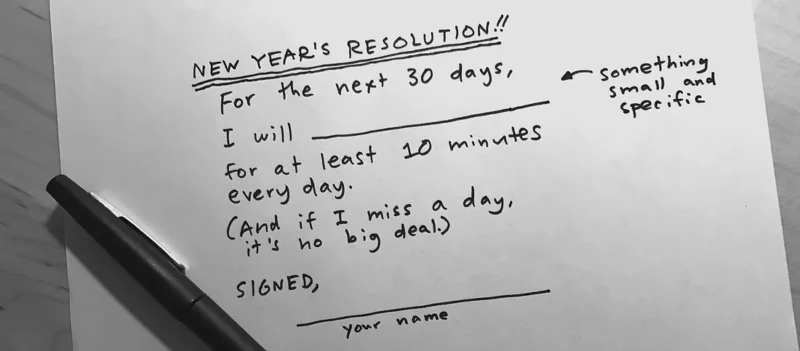
So as we enter 2026, let’s remember to work with our brain’s natural learning system: Frame your goals positively, break them into manageable steps, and celebrate small wins along the way.