
A15 – Auf welchem Vorhersagefehler basiert Extinktion?
Harald Lachnit, Metin Üngör (associated investigator)
In fünf voneinander unabhängigen Arbeitspaketen werden wir fundamentale Vorhersagen unter der Annahme einer Fehlerkorrektur basierend auf allen gleichzeitig anwesenden Prädiktoren untersuchen, insbesondere, dass die nicht-verstärkte Darbietung eines Hinweisreizes weder notwendig noch hinreichend ist um Extinktion zu induzieren. Stattdessen sollten die Art und die Stärke des Fehlersignals in der spezifischen Lernsituation entscheidende Faktoren sein. Wir wollen herausfinden, wie Organismen multiple Signale zu einem Vorhersagemodell von Umweltereignissen integrieren und wie die Prädiktionswerte multipler Signale durch Erfahrung so moduliert werden, dass die Vorhersage mit der Realität in Übereinstimmung gebracht wird.
Leitfragen des Projekts A15:
- Wird Extinktion durch die Stärke negativer Vorhersagefehler moduliert?
- Führen Ergebnisauslassungen zur Akquisition, wenn das Ergebnis unter den Erwartungen liegt?
- Führen Ergebnisbeschneidungen zur Extinktion, wenn das Ergebnis über den Erwartungen liegt?
- Wird die Akquisition durch die Stärke positiver Vorhersagefehler moduliert?
- Wird Extinktion bei mehreren Stimuli durch das gleiche Fehlersignal ausgelöst?



9 projektrelevante Publikationen
Lipp J, Draganova R, Batsikadze G, Ernst TM, Uengoer M, Timmann D (2019) Prefrontal but not cerebellar tDCS attenuates renewal of extinguished conditioned eyeblink responses. Neurobiol Learn Mem: 107137.
Nieto J, Mason TA, Bernal-Gamboa R, Uengoer M (2020) The impacts of acquisition and extinction cues on ABC renewal of voluntary behaviors. Learn Mem. 27(3): 114–118.
Packheiser J, Pusch R, Stein CC, Güntürkün O, Lachnit H, Uengoer M (2020) How competitive is cue competition? Q J Exp Psychol. 73(1): 104–114.
Steiner KM, Jansen S, Adeishvili N, Hulst T, Ernst TM, Müller O, Wondzinski E, Göricke SL, Siebler M, Uengoer M, Timmann D (2020) Extinction of cognitive associations is preserved in patients with cerebellar disease. Neurobiol Learn Mem. 169: 107185.
Uengoer M, Klass A, Tegenthoff M, Lissek S (2020) Test-retest reliability of response recovery after discrimination reversal learning. Behav Processes. 176: 104107.
Uengoer M, Lachnit H, Pearce JM (2019) The fate of redundant cues in human predictive learning: The outcome ratio effect. Q J Exp Psychol. 72(8): 1747021818820042.
Uengoer M, Lachnit H, Pearce JM (2020) The role of common elements in the redundancy effect. J Exp Psychol Anim Learn Cogn. 46(3): 286–296.
Uengoer M, Lissek S, Tegenthoff M, Manahan-Vaughan D, Lachnit H (2020) Principles of extinction learning of nonaversive experience. Neuroforum. 26(3): 151–158.
Uengoer M, Thorwart A, Lucke S, Woehr M, Lachnit H (2020) Adding or removing context components equally disrupts extinction in human predictive learning. Behav Processes. 179.

New Year, New Me: The Facts
As the calendar turns to a new year, millions of people around the world commit to New Year’s resolutions, making promises to use the new year as a fresh beginning and an opportunity for transformation. In 2024, almost three-quarters of the British population set themselves New Year’s resolutions — that’s around 40 million people (or the entire population of Canada). This tradition was particularly strong among younger generations, with 96% of Generation Z (aged 18-27) planning resolutions, compared to just 35% of the Silent Generation (aged 79+).
Most common new years resolutions:
- Saving more money (52%)
- Eat healthier (50%)
- Exercise more (48%)
- Lose weight (37%)
- Spend more time with family/friends (35%)
How long do most resolutions normally last before being broken?
- Data from America (2016) shows that 75% of individuals maintain their resolutions through the first week.
- 64% of individuals maintain their resolutions through the first month.
- 46% of individuals in America keep their resolutions past the 6-month mark.
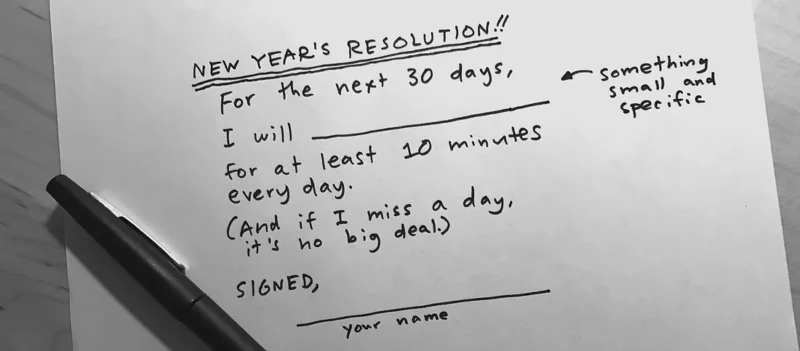
What makes resolutions stick?
Oscarsson et al. (2020) conducted research into what makes New Year’s resolutions stick. Biggest success rates depended on how people phrased their goals. Participants who set approach-oriented goals (trying to move toward or maintain a desirable outcome or state) than those with avoidance-oriented goals (trying to move toward or maintain a desirable outcome or state) were significantly more successful (58.9% vs. 47.1%) at sticking to their goals.
The study also investigates the effects of outside support. These participants received monthly follow-ups and emails with information and exercises for coping with hurdles when striving toward personal goals, and were also encouraged to set goals using the SMART technique and to set interim goals. The group that received some support was exclusively and significantly more successful compared to the groups who received a lot of support or no support at all.
Additionally, you might feel more successful if you set goals that are measurable in numbers. While success for a person striving to quit smoking or lose weight could easily be measured in the number of cigarettes smoked or body mass index, the success for a person striving to „take better care of themselves“ could be highly subjective and possibly impossible to measure.
So as we enter 2026, let’s remember to work with our brain’s natural learning system: Frame your goals positively, break them into manageable steps, and celebrate small wins along the way.