A01 A02 A03 A04 A05 A06 A07 A09 A10 A11 A12 A13 A14 A18 A19 A21 F01 F02 INF Ö

A08 – Strukturelle, prozess- und kontextbezogene Faktoren die den Renewal-Effekt der Extinktion vermitteln

Silke Lissek, Martin Tegenthoff

Wir werden potentielle Einflussfaktoren auf den Renewal-Effekt der Extinktion erforschen, d.h. externale (kontextbezogene) sowie internale (strukturelle und prozessbezogene) potentielle Moderatorvariablen. Durch Manipulation von Kontext-Salienz und -Generalisierbarkeit werden wir die Kontextverarbeitung und somit das Ausmaß von Renewal verändern. Durch pharmakologische Intervention werden wir das initiale Assoziationslernen modulieren, um dessen potentielle Auswirkungen auf Renewal zu ermitteln. Mit verschiedenen Neuroimaging-Methoden werden wir aufgabenbezogene Aktivierung in extinktionsrelevanten Hirnregionen, funktionelle und strukturelle Konnektivität sowie Hirnstruktur mit der Tendenz zu Renewal in Beziehung setzen.

Leitfragen des Projekts A08:

  • Bis zu welchem Grad können Struktur- oder Prozess-verknüpfte Moderatoren die Wahrscheinlichkeit eines Renewal vorhersagen?
  • Kann Renewal durch modulierende kontextabhängige Moderatoren wie Salienz oder Generalisierbarkeit verstärkt oder reduziert werden, bei korrespondierenden Auswirkungen auf die Aktivierungsmuster des Gehirns?

Silke Lissek

Projektleiterin A08

Ruhr-Universität Bochum

Martin Tegenthoff

Projektleiter A08

Ruhr-Universität Bochum

Anne Klass

Postdoc A08

Ruhr-Universität Bochum

Alina Nostadt

Doktorandin A08

Ruhr-Universität Bochum

10 projektrelevante Publikationen

Klass A, Glaubitz B, Tegenthoff M, Lissek S (2017) D-Cycloserine facilitates extinction learning and enhances extinction-related brain activation. Neurobiol Learn Mem. 144: 235–247.

Lissek S, Glaubitz B, Klass A, Tegenthoff M (2018) The effects of dopaminergic stimulation upon behavioral and neural correlates of renewal depend on individual context processing propensities. NeuroImage. 169: 69–79.

Lissek S, Glaubitz B, Schmidt-Wilcke T, Tegenthoff M (2016) Hippocampal context processing during acquisition of a predictive learning task is associated with renewal in extinction recall. J Cogn Neurosci. 28: 747–762.

Lissek S, Glaubitz B, Uengoer M, Tegenthoff M (2013) Hippocampal activation during extinction learning predicts occurrence of the renewal effect in extinction recall. NeuroImage. 81: 131–143.

Lissek S, Klass A, Tegenthoff M (2019) Effects of noradrenergic stimulation upon context-related extinction learning performance and BOLD activation in hippocampus and prefrontal cortex differ between participants showing and not showing renewal. Front Behav Neurosci. 13: 78.

Lissek S, Klass A, Tegenthoff M (2020) Left inferior frontal gyrus participates in mediating the renewal effect irrespective of context salience. Front Behav Neurosci. 14: 43.

Meier Drexler S, Merz CJ, Lissek S, Tegenthoff M, Wolf OT (2019) Reactivation of the unconditioned stimulus inhibits the return of fear independent of cortisol. Front Behav Neurosci. 13: 254.

Raeder F, Merz CJ, Tegenthoff M, Wolf OT, Margraf J, Zlomuzica A (2019) Post-exposure cortisol administration does not augment the success of exposure therapy: A randomized placebo-controlled study. Psychoneuroendocrinology. 99: 174–182.

Uengoer M, Klass A, Tegenthoff M, Lissek S (2020) Test-retest reliability of response recovery after discrimination reversal learning. Behav Processes. 176: 104107.

Uengoer M, Lissek S, Tegenthoff M, Manahan-Vaughan D, Lachnit H (2020) Principles of extinction learning of non-aversive experience. Neuroforum. 26(3): 151–158.


New Year, New Me: The Facts

As the calendar turns to a new year, millions of people around the world commit to New Year’s resolutions, making promises to use the new year as a fresh beginning and an opportunity for transformation. In 2024, almost three-quarters of the British population set themselves New Year’s resolutions — that’s around 40 million people (or the entire population of Canada). This tradition was particularly strong among younger generations, with 96% of Generation Z (aged 18-27) planning resolutions, compared to just 35% of the Silent Generation (aged 79+).

Most common new years resolutions:

  1. Saving more money (52%)
  2. Eat healthier (50%)
  3. Exercise more (48%)
  4. Lose weight (37%)
  5. Spend more time with family/friends (35%)

How long do most resolutions normally last before being broken?

  • Data from America (2016) shows that 75% of individuals maintain their resolutions through the first week. 
  • 64% of individuals maintain their resolutions through the first month. 
  • 46% of individuals in America keep their resolutions past the 6-month mark.

What makes resolutions stick?

Oscarsson et al. (2020) conducted research into what makes New Year’s resolutions stick. Biggest success rates depended on how people phrased their goals. Participants who set approach-oriented goals (trying to move toward or maintain a desirable outcome or state) than those with avoidance-oriented goals (trying to move toward or maintain a desirable outcome or state) were significantly more successful (58.9% vs. 47.1%) at sticking to their goals.

The study also investigates the effects of outside support. These participants received monthly follow-ups and emails with information and exercises for coping with hurdles when striving toward personal goals, and were also encouraged to set goals using the SMART technique and to set interim goals. The group that received some support was exclusively and significantly more successful compared to the groups who received a lot of support or no support at all. 

Additionally, you might feel more successful if you set goals that are measurable in numbers. While success for a person striving to quit smoking or lose weight could easily be measured in the number of cigarettes smoked or body mass index, the success for a person striving to „take better care of themselves“ could be highly subjective and possibly impossible to measure.

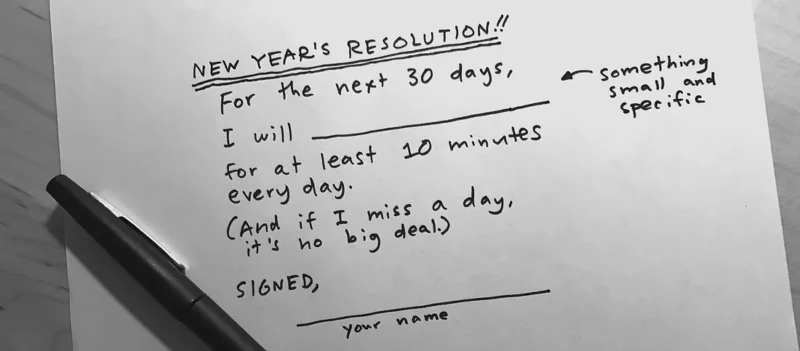
So as we enter 2026, let’s remember to work with our brain’s natural learning system: Frame your goals positively, break them into manageable steps, and celebrate small wins along the way.