
A02 – Neuronale Mechanismen der Kontextgeneralisierung
Nikolai Axmacher
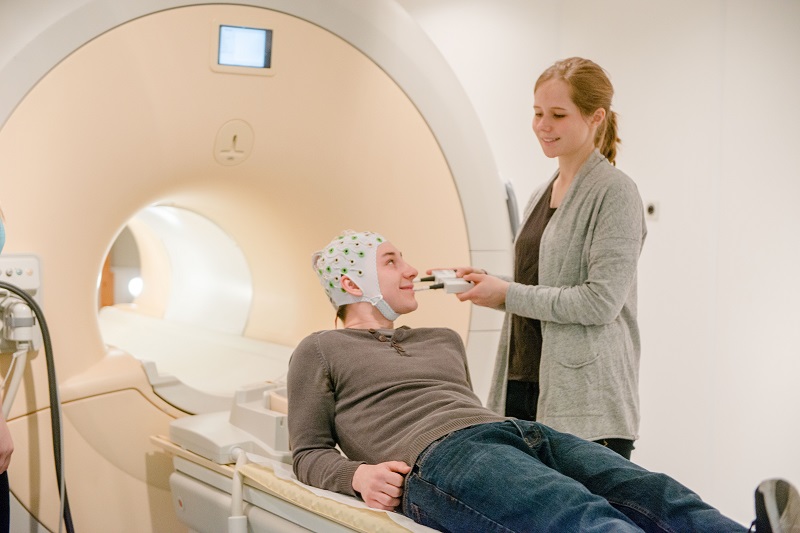
Während Kontexte während des initialen Lernens häufig generalisieren, ist Extinktion stärker kontextabhängig. Im Projekt sollen die Mechanismen untersucht werden, die Distinktheit oder Generalisierung von Kontexten während Lernen und Extinktion verursachen. Stimulus-spezifische Kontextrepräsentationen werden durch multivariate Analysemethoden in simultanen EEG/fMRT-Messungen bei gesunden Probanden sowie in intrakraniellen EEG- und Einzelzellableitungen bei Epilepsiepatienten identifiziert. Dieser multimethodische Ansatz ist ideal geeignet, um eine Brücke zwischen tier- und humanexperimentellen Studien zum Extinktionslernen herzustellen.
Leitfragen des Projekts A02:
- Wie werden beim Menschen spezifische Kontexte über mehrere Ebenen der Gehirnorganisation hinweg dargestellt?
- Wie ändern sich die neuronalen Repräsentationen von Kontexten während des ursprünglichen Lernerwerbs und dem Extinktionslernen?
- Ist die Generalisierbarkeit oder Unterscheidbarkeit von Kontextdarstellungen während des Lernerwerbs und des Extinktionslernens prädiktiv ob eine Erneuerung oder Extinktion eintreten wird?
- Welche neuralen Mechanismen unterstützen diese Repräsentationsänderungen?


10 projektrelevante Publikationen
Bierbrauer A, Fellner M-C, Heinen R, Wolf OT, Axmacher N (2021) The memory trace of a stressful episode. Curr Biol 31:5204-5213.e8. https://doi.org/10.1016/j.cub.2021.09.044
Bouyeure A, Pacheco D, Fellner M-C, Jacob G, Kobelt M, Rose J, Axmacher N (2025) Distinct representational properties of cues and contexts shape fear learning and extinction. bioRxiv:2024.12.16.628638. https://doi.org/10.1101/2024.12.16.628638
Chen S, Tan Z, Xia W, Gomes CA, Zhang X, Zhou W, Liang S, Axmacher N, Wang L (2021) Theta oscillations synchronize human medial prefrontal cortex and amygdala during fear learning. Sci Adv 7. https://doi.org/10.1126/sciadv.abf4198
Costa M, Lozano-Soldevilla D, Gil-Nagel A, Toledano R, Oehrn CR, Kunz L, Yebra M, Mendez-Bertolo C, Stieglitz L, Sarnthein J, Axmacher N, Moratti S, Strange BA (2022) Aversive memory formation in humans involves an amygdala-hippocampus phase code. Nat Commun 13:6403. https://doi.org/10.1038/s41467-022-33828-2
Kobelt M, Waldhauser GT, Rupietta A, Heinen R, Rau EMB, Kessler H, Axmacher N (2024) The memory trace of an intrusive trauma-analog episode. Curr Biol 34:1657-1669.e5. https://doi.org/10.1016/j.cub.2024.03.005
Kunz L, Wang L, Lachner-Piza D, Zhang H, Brandt A, Dümpelmann M, Reinacher PC, Coenen VA, Chen D, Wang WX, Zhou W, Liang S, Grewe P, Bien CG, Bierbrauer A, Navarro Schröder T, Schulze-Bonhage A, Axmacher N (2019) Hippocampal theta phases organize the reactivation of large-scale electrophysiological representations during goal-directed navigation. Sci Adv 5:eaav8192. https://doi.org/10.1126/sciadv.aav8192
Pacheco Estefan D, Zucca R, Arsiwalla X, Principe A, Zhang H, Rocamora R, Axmacher N, Verschure PFMJ (2021) Volitional learning promotes theta phase coding in the human hippocampus. Proc Natl Acad Sci U S A 118(10): e2021238118. https://doi.org/10.1073/pnas.2021238118
Pacheco, Estefan D, Bouyeure, A, Jacobs G, Fellner MC, Lehongre K, Lambrecq V, Frazzini V, Navarro V, Güntürkün O, Shen L, Yang J, Han B, Chen Q, Axmacher N (2025) Representational dynamics during extinction of fear memories in the human brain. Nature human behaviour (accepted pending minor revisions) bioRxiv 2025.04.26.650560 https://doi.org/10.1101/2025.04.26.650560
Pfaffenrot V, Bouyeure A, Gomes CA, Kashyap S, Axmacher N, Norris DG (2024) Characterizing BOLD activation patterns in the human hippocampus with laminar fMRI. bioRxiv:2024.07.04.602065. https://doi.org/10.1101/2024.07.04.602065
Rau EMB, Fellner M-C, Heinen R, Zhang H, Yin Q, Vahidi P, Kobelt M, Asano E, Kim-McManus O, Sattar S, Lin JJ, Auguste KI, Chang EF, King-Stephens D, Weber PB, Laxer KD, Knight RT, Johnson EL, Ofen N, Axmacher N (2025) Reinstatement and transformation of memory traces for recognition. Sci Adv 11:eadp9336. https://doi.org/10.1126/sciadv.adp9336
New Year, New Me: The Facts
As the calendar turns to a new year, millions of people around the world commit to New Year’s resolutions, making promises to use the new year as a fresh beginning and an opportunity for transformation. In 2024, almost three-quarters of the British population set themselves New Year’s resolutions — that’s around 40 million people (or the entire population of Canada). This tradition was particularly strong among younger generations, with 96% of Generation Z (aged 18-27) planning resolutions, compared to just 35% of the Silent Generation (aged 79+).
Most common new years resolutions:
- Saving more money (52%)
- Eat healthier (50%)
- Exercise more (48%)
- Lose weight (37%)
- Spend more time with family/friends (35%)
How long do most resolutions normally last before being broken?
- Data from America (2016) shows that 75% of individuals maintain their resolutions through the first week.
- 64% of individuals maintain their resolutions through the first month.
- 46% of individuals in America keep their resolutions past the 6-month mark.
What makes resolutions stick?
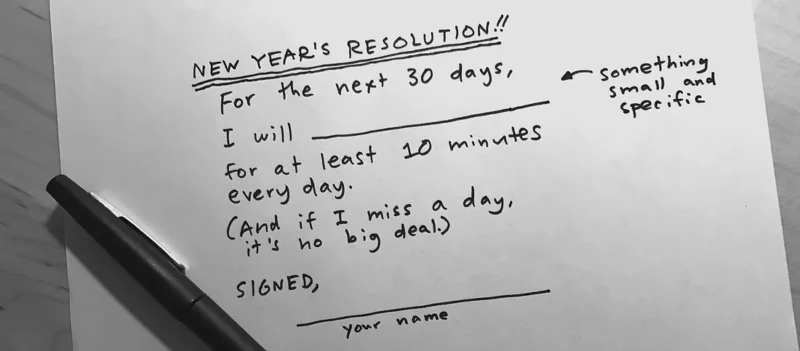
Oscarsson et al. (2020) conducted research into what makes New Year’s resolutions stick. Biggest success rates depended on how people phrased their goals. Participants who set approach-oriented goals (trying to move toward or maintain a desirable outcome or state) than those with avoidance-oriented goals (trying to move toward or maintain a desirable outcome or state) were significantly more successful (58.9% vs. 47.1%) at sticking to their goals.
The study also investigates the effects of outside support. These participants received monthly follow-ups and emails with information and exercises for coping with hurdles when striving toward personal goals, and were also encouraged to set goals using the SMART technique and to set interim goals. The group that received some support was exclusively and significantly more successful compared to the groups who received a lot of support or no support at all.
Additionally, you might feel more successful if you set goals that are measurable in numbers. While success for a person striving to quit smoking or lose weight could easily be measured in the number of cigarettes smoked or body mass index, the success for a person striving to „take better care of themselves“ could be highly subjective and possibly impossible to measure.
So as we enter 2026, let’s remember to work with our brain’s natural learning system: Frame your goals positively, break them into manageable steps, and celebrate small wins along the way.