A01 A02 A03 A04 A05 A06 A07 A09 A10 A11 A12 A13 A14 A18 A19 A21 F01 F02 INF Ö

A19 – Kausalität und neuronale Dynamik von Kontext und Generalisierung

Jonas Rose

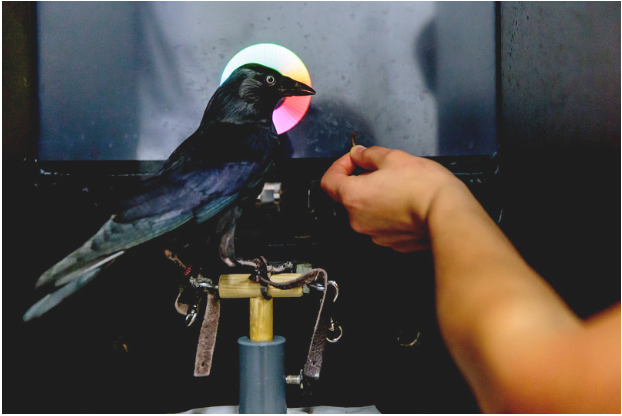
Extinktionslernen ist kontextabhängig. Ob Kontext-Stimuli jedoch bestimmte physikalische Eigenschaften haben oder ob sie allein durch Lernen definiert sind, ist noch ungeklärt. In einem neuen Versuchsaufbau werden wir dies in Tauben zunächst korrelativ auf Verhaltensebene und anschließend kausal durch optogenetische Stimulation untersuchen. Im Anschluss werden wir neruonale Aktivitäten in Krähen mit modernen neurophysiologischen Methoden messen, um festzustellen,  inwiefern die unterschiedliche Kontextabhängigkeit von Extinktion und Akquisition auf Aufmerksamkeits- oder Generalisierungsmechanismen beruhen. 

Leitfragen des Projekts A19:

  • Wird der Kontext nur durch Kontingenz und Kontinuität definiert, oder gibt es physikalische Eigenschaften, die eher zu einem Kontext werden? Können wir die Kausalität in dem zugrunde liegenden neuronalen Netz durch optogenetischer Manipulation?
  • Ist der Hippocampus von Vögeln an der Kontextabhängigkeit des Extinktionslernens beteiligt?
  • Ist der Unterschied in der Kontextabhängigkeit zwischen Erwerb und Auslöschung ein Unterschied in der Aufmerksamkeit oder in der Generalisierung?
  • Sind individuelle Unterschiede bei der Auslöschung/Erneuerung allein durch die Verstärkungsgeschichte bedingt oder sind Regeln und Strategien beteiligt? Sind solche Ergebnisse bei verschiedenen Arten stabil?

Jonas Rose

Projektleiter A19

Ruhr-Universität Bochum

Juan M. Peschken

Doktorand A19

Ruhr-Universität Bochum

Sara Santos Silva

Doktorandin A19

Ruhr-Universität Bochum

Farina Lingstädt

Doktorandin A19

Ruhr-Universität Bochum

10 projektrelevante Publikationen

Bouyeure A, Fellner M-C, Pacheco D, Kobelt M, Jacob G, Rose J, Axmacher N, (2025) Distinct representational properties of cues and context shape fear learning: an fMRI study. eLife 14:RP105126. https://doi.org/10.7554/eLife.105126 

Güntürkün O, Pusch R, Rose J (2024): Why birds are smart. In Trends in Cognitive Sciences 28 (3), pp. 197–209. https://doi.org/10.1016/j.tics.2023.11.002 

Hahn LA, Balakhonov D, Lundqvist M, Nieder A, Rose J (2022). Oscillations without cortex: Working memory modulates brainwaves in the endbrain of crows. Progress in Neurobiology, 219, 102372. https://doi.org/10.1016/j.pneurobio.2022.102372 

Hahn LA, Fongaro E, Rose J (2025) Neuronal correlates of selective attention in the endbrain of crows. Communications Biology, 8:470. https://doi.org/10.1038/s42003-025-07914-2 

Lingstädt F, Apostel A and Rose J (2025) Distribution of dominant wavelengths predicts jackdaw (Corvus monedula) color discrimination performance. Front. Physiol. 16:1543469. https://doi.org/10.3389/fphys.2025.1543469 

Otto T, Rose J (2024): The open toolbox for behavioral research. Behavior Research Methods. 56(5):4522-4529. https://doi.org/10.3758/s13428-023-02199-x 

Peschken J, Hahn LA, Pusch R, Rose J (2025) Extinction context is learned by pigeons, not given by the environment. Communications Psychology, 3(1). https://doi.org/10.1038/s44271-025-00261-2 

Pusch R, Packheiser J, Azizi AH, Sevincik CS, Rose J, Cheng S, Stüttgen MC, Güntürkün O (2023): Working memory performance is tied to stimulus complexity. Communications Biology, 6(1). https://doi.org/10.1038/s42003-023-05486-7 

Röders D, Ballesteros J, Sevincik CS, Silva SS, Abbas B, Bürgel L, Pusch R, Rose J (2025) A 3D-printed, modular implant for extracellular recordings. Journal of Neuroscience Methods, 418:110407. https://doi.org/10.1016/j.jneumeth.2025.110407 

Serir A, Tuff JM, Rook N, Fongaro E, Schreiber T, Peus E, Güntürkün O, Manahan-Vaughan D, Rose J, Pusch R (2024) Balanced anesthesia in pigeons (Columba livia): a protocol that ensures stable vital parameters and feasibility during long surgeries in cognitive neuroscience. Frontiers in Physiology: Avian Physiology, 15. https://doi.org/10.3389/fphys.2024.1437890

New Year, New Me: The Facts

As the calendar turns to a new year, millions of people around the world commit to New Year’s resolutions, making promises to use the new year as a fresh beginning and an opportunity for transformation. In 2024, almost three-quarters of the British population set themselves New Year’s resolutions — that’s around 40 million people (or the entire population of Canada). This tradition was particularly strong among younger generations, with 96% of Generation Z (aged 18-27) planning resolutions, compared to just 35% of the Silent Generation (aged 79+).

Most common new years resolutions:

  1. Saving more money (52%)
  2. Eat healthier (50%)
  3. Exercise more (48%)
  4. Lose weight (37%)
  5. Spend more time with family/friends (35%)

How long do most resolutions normally last before being broken?

  • Data from America (2016) shows that 75% of individuals maintain their resolutions through the first week. 
  • 64% of individuals maintain their resolutions through the first month. 
  • 46% of individuals in America keep their resolutions past the 6-month mark.

What makes resolutions stick?

Oscarsson et al. (2020) conducted research into what makes New Year’s resolutions stick. Biggest success rates depended on how people phrased their goals. Participants who set approach-oriented goals (trying to move toward or maintain a desirable outcome or state) than those with avoidance-oriented goals (trying to move toward or maintain a desirable outcome or state) were significantly more successful (58.9% vs. 47.1%) at sticking to their goals.

The study also investigates the effects of outside support. These participants received monthly follow-ups and emails with information and exercises for coping with hurdles when striving toward personal goals, and were also encouraged to set goals using the SMART technique and to set interim goals. The group that received some support was exclusively and significantly more successful compared to the groups who received a lot of support or no support at all. 

Additionally, you might feel more successful if you set goals that are measurable in numbers. While success for a person striving to quit smoking or lose weight could easily be measured in the number of cigarettes smoked or body mass index, the success for a person striving to „take better care of themselves“ could be highly subjective and possibly impossible to measure.

So as we enter 2026, let’s remember to work with our brain’s natural learning system: Frame your goals positively, break them into manageable steps, and celebrate small wins along the way.