A01 A02 A03 A04 A05 A06 A07 A09 A10 A11 A12 A13 A14 A18 A19 A21 F01 F02 INF Ö

A10 – From Pavlov to Pain: Extinktionslernen bei viszeralen Schmerzen

Sigrid Elsenbruch, Adriane Icenhour

Veränderte Lern- und Gedächtnisprozesse sind für die Pathophysiologie und Therapie chronischer Schmerzen von großer Bedeutung. Die geplanten Forschungsarbeiten haben das übergeordnete Ziel, behaviorale und neurale Mechanismen und klinische Implikationen des Extinktionslernens in einem interozeptiven, viszeralen Schmerzmodell zu analysieren. Es soll zunächst geprüft werden, ob die Extinktion konditionierter Schmerz-assoziierter Furcht beim Reizdarmsyndrom spezifisch für die viszerale Modalität verändert ist. Darüber wird bei Gesunden getestet, ob Hydrocortison im Vergleich zu Placebo das Reinstatement verstärkt. Abschließend soll ein neues Paradigma der interozeptiven Kontextkonditionierung mit viszeralen konditionierten Reizen implementiert werden.

Leitfragen des Projekts A10:

  • Sind verändertes Erlernen und gestörte Extinktion von schmerzbezogener Furcht bei Patienten mit Reizdarmsyndrom spezifisch für viszerale Schmerzen?
  • Wirken interozeptive Reize als konditionierte Stimuli in einem neuartigen kontextuellen, interozeptiven Konditionierungsparadigma?
  • Können wir in diesem Paradigma reinstatement- und renewal-Effekte zeigen?
  • Beeinflusst das Stresshormon Cortisol schmerzbezogenes Extinktionslernen?

Sigrid Elsenbruch

Projektleiterin A10, A12

Ruhr-Universität Bochum

Adriane Icenhour

Projektleiterin A10

Universität Duisburg-Essen

Franziska Labrenz

Postdoc A10, A12

Ruhr-Universität Bochum / Universität Duisburg-Essen

Genisius Hartanto

Postdoc A10

Ruhr-Universität Bochum

Laura R. Lanters née Koenen

Postdoc A10

Ruhr-Universität Bochum

Dominic Pundt

Doktorand A10

Ruhr-Universität Bochum

Katharina Koch

Doktorandin A10

Ruhr-Universität Bochum

Cornelia Klukowski

Doktorandin A10

Ruhr-Universität Bochum

10 projektrelevante Publikationen

Icenhour A, Petrakova L, Hazzan N, Theysohn N, Merz CJ, Elsenbruch S (2021) When gut feelings teach the brain to fear pain: Context-dependent activation of the central fear network in a novel interoceptive conditioning paradigm. Neuroimage 238:118229. https://doi.org/10.1016/j.neuroimage.2021.118229 

Icenhour A, Kattoor J, Benson S, Boekstegers A, Schlamann M, Merz CJ, Forsting M, Elsenbruch S (2015a) Neural circuitry underlying effects of context on human pain-related fear extinction in a renewal paradigm. Hum Brain Mapp 36:3179–3193. https://doi.org/10.1002/hbm.22837

Icenhour A, Langhorst J, Benson S, Schlamann M, Hampel S, Engler H, Forsting M, Elsenbruch S (2015b) Neural circuitry of abdominal pain-related fear learning and reinstatement in irritable bowel syndrome. Neurogastroenterol Motil. 27:114–127. https://doi.org/10.1111/nmo.12489

Keefer L, Ballou SK, Drossman DA, Ringstrom G, Elsenbruch S, Ljótsson B (2022) A Rome Working Team Report on Brain-Gut Behavior Therapies for Disorders of Gut-Brain Interaction. Gastroenterology 162:300–315. https://doi.org/10.1053/j.gastro.2021.09.015

Koenen LR, Pawlik RJ, Icenhour A, Petrakova L, Forkmann K, Theysohn N, Engler H, Elsenbruch S (2021) Associative learning and extinction of conditioned threat predictors across sensory modalities. Commun Biol 4:553. https://doi.org/10.1038/s42003-021-02008-1 

Koenen LR, Icenhour A, Forkmann K, Theysohn N, Forsting M, Bingel U, Elsenbruch S (2018) From Anticipation to the Experience of Pain: The Importance of Visceral Versus Somatic Pain Modality in Neural and Behavioral Responses to Pain-Predictive Cues. Psychosom Med 80:826–835. https://doi.org/10.1097/PSY.0000000000000612

Labrenz F, Spisák T, Ernst TM, Gomes CA, Quick HH, Axmacher N, Elsenbruch S, Timmann D (2022a) Temporal dynamics of fMRI signal changes during conditioned interoceptive pain-related fear and safety acquisition and extinction. Behav Brain Res 427:113868. https://doi.org/10.1016/j.bbr.2022.113868 

Labrenz F, Icenhour A, Schlamann M, Forsting M, Bingel U, Elsenbruch S (2016) From Pavlov to pain: How predictability affects the anticipation and processing of visceral pain in a fear conditioning paradigm. Neuroimage 130:104–114. https://doi.org/10.1016/j.neuroimage.2016.01.064

Lanters LR, Öhlmann H, Langhorst J, Theysohn N, Engler H, Icenhour A*, Elsenbruch S* (2024) Disease-specific alterations in central fear network engagement during acquisition and extinction of conditioned interoceptive fear in inflammatory bowel disease. Mol Psychiatry 29:3527–3536. (*equal contribution) https://doi.org/10.1038/s41380-024-02612-7 

Öhlmann H, Lanters LR, Theysohn N, Langhorst J, Engler H, Icenhour A, Elsenbruch S (2023) Distinct Alterations in Central Pain Processing of Visceral and Somatic Pain in Quiescent Ulcerative Colitis Compared to Irritable Bowel Syndrome and Health. J Crohns Colitis 17:1639–1651. https://doi.org/10.1093/ecco-jcc/jjad080


New Year, New Me: The Facts

As the calendar turns to a new year, millions of people around the world commit to New Year’s resolutions, making promises to use the new year as a fresh beginning and an opportunity for transformation. In 2024, almost three-quarters of the British population set themselves New Year’s resolutions — that’s around 40 million people (or the entire population of Canada). This tradition was particularly strong among younger generations, with 96% of Generation Z (aged 18-27) planning resolutions, compared to just 35% of the Silent Generation (aged 79+).

Most common new years resolutions:

  1. Saving more money (52%)
  2. Eat healthier (50%)
  3. Exercise more (48%)
  4. Lose weight (37%)
  5. Spend more time with family/friends (35%)

How long do most resolutions normally last before being broken?

  • Data from America (2016) shows that 75% of individuals maintain their resolutions through the first week. 
  • 64% of individuals maintain their resolutions through the first month. 
  • 46% of individuals in America keep their resolutions past the 6-month mark.

What makes resolutions stick?

Oscarsson et al. (2020) conducted research into what makes New Year’s resolutions stick. Biggest success rates depended on how people phrased their goals. Participants who set approach-oriented goals (trying to move toward or maintain a desirable outcome or state) than those with avoidance-oriented goals (trying to move toward or maintain a desirable outcome or state) were significantly more successful (58.9% vs. 47.1%) at sticking to their goals.

The study also investigates the effects of outside support. These participants received monthly follow-ups and emails with information and exercises for coping with hurdles when striving toward personal goals, and were also encouraged to set goals using the SMART technique and to set interim goals. The group that received some support was exclusively and significantly more successful compared to the groups who received a lot of support or no support at all. 

Additionally, you might feel more successful if you set goals that are measurable in numbers. While success for a person striving to quit smoking or lose weight could easily be measured in the number of cigarettes smoked or body mass index, the success for a person striving to „take better care of themselves“ could be highly subjective and possibly impossible to measure.

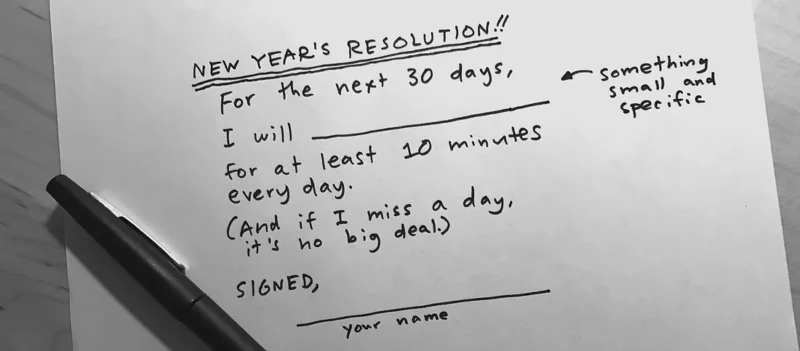
So as we enter 2026, let’s remember to work with our brain’s natural learning system: Frame your goals positively, break them into manageable steps, and celebrate small wins along the way.