A01 A02 A03 A04 A05 A06 A07 A09 A10 A11 A12 A13 A14 A18 A19 A21 F01 F02 INF Ö

V. Berlin-Bochum Memory Alliance Symposium

30. Januar 2026

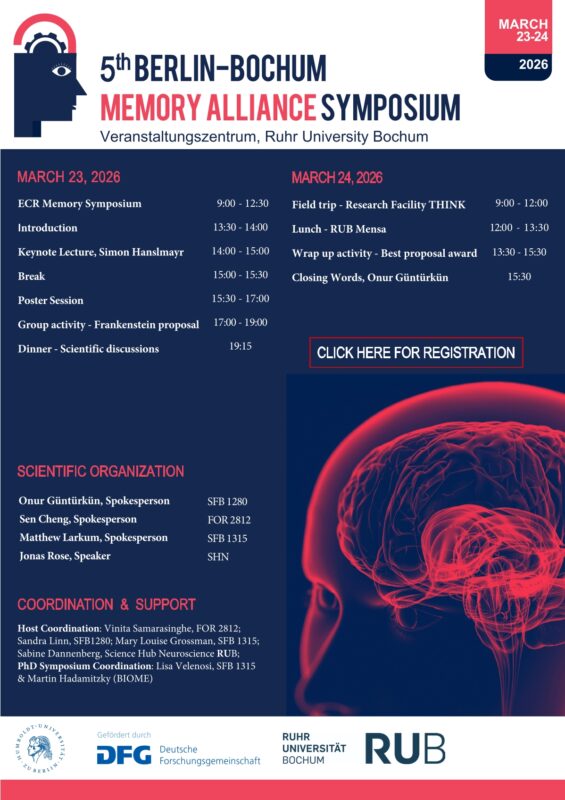
Die Berlin-Bochum Memory Alliance trifft sich wieder!

Während 2025 ganz im Zeichen der ECRs stand, ist es nun an der Zeit, die gesamte Allianz wieder zusammenzubringen. Dieses Mal treffen wir uns vom 23. bis 24.03.2026 in Bochum, und werden unsere Arbeit teilen, Kontakte vertiefen – und großartige Frankenstein-Anträge kreieren.

Liebe Mitglieder des SFB 1280, SFB 1315, FOR 2812 und des Science Hub Neuroscience, bitte meldet euch bis zum 23.02. über den Eveeno-Link an, den euch euer Koordinator per E-Mail zugeschickt hat.


Was euch erwartet – die vorläufige Agenda

March 23, 2026

09:00–ca 12:30 

ECR Symposium  | All PhD and Postdocs are invited

*13:30–14:00

Introduction 

14:00–15:00

Keynote | Simon Hanslmayr    Hanslmayr_Abstract.pdf

15:00-15:30

Break

15:30-17:00

Poster session 

17:00-19:00

Group activity | Frankenstein proposal**

19:15

Dinner at Q-West | Scientific discussions

March 24, 2026

09:00–12:00

Field trip | Research Facility THINK

12:00–13:30

Lunch | RUB Mensa

13:30–15:30

Wrap up group activity | Best proposal award 

15:30

Closing Words, Onur Güntürkün

* Guests are welcome to take lunch at RUB (Canteen, Rote Beete (vegan), Q-West >>)

** The Frankenstein Propoasl – a method mash up!
Most mixed groups of 4-5 persons bring together their expertise and wildest ideas to design a bold joint experiment in limited time. The sky is the limit for budget, there are no laws and no ethics approval is required. What monsters will come to life? 

>> Our Alliance’s Website: www.memory-alliance.de


New Year, New Me: The Facts

As the calendar turns to a new year, millions of people around the world commit to New Year’s resolutions, making promises to use the new year as a fresh beginning and an opportunity for transformation. In 2024, almost three-quarters of the British population set themselves New Year’s resolutions — that’s around 40 million people (or the entire population of Canada). This tradition was particularly strong among younger generations, with 96% of Generation Z (aged 18-27) planning resolutions, compared to just 35% of the Silent Generation (aged 79+).

Most common new years resolutions:

  1. Saving more money (52%)
  2. Eat healthier (50%)
  3. Exercise more (48%)
  4. Lose weight (37%)
  5. Spend more time with family/friends (35%)

How long do most resolutions normally last before being broken?

  • Data from America (2016) shows that 75% of individuals maintain their resolutions through the first week. 
  • 64% of individuals maintain their resolutions through the first month. 
  • 46% of individuals in America keep their resolutions past the 6-month mark.

What makes resolutions stick?

Oscarsson et al. (2020) conducted research into what makes New Year’s resolutions stick. Biggest success rates depended on how people phrased their goals. Participants who set approach-oriented goals (trying to move toward or maintain a desirable outcome or state) than those with avoidance-oriented goals (trying to move toward or maintain a desirable outcome or state) were significantly more successful (58.9% vs. 47.1%) at sticking to their goals.

The study also investigates the effects of outside support. These participants received monthly follow-ups and emails with information and exercises for coping with hurdles when striving toward personal goals, and were also encouraged to set goals using the SMART technique and to set interim goals. The group that received some support was exclusively and significantly more successful compared to the groups who received a lot of support or no support at all. 

Additionally, you might feel more successful if you set goals that are measurable in numbers. While success for a person striving to quit smoking or lose weight could easily be measured in the number of cigarettes smoked or body mass index, the success for a person striving to „take better care of themselves“ could be highly subjective and possibly impossible to measure.

So as we enter 2026, let’s remember to work with our brain’s natural learning system: Frame your goals positively, break them into manageable steps, and celebrate small wins along the way.