A01 A02 A03 A04 A05 A06 A07 A09 A10 A11 A12 A13 A14 A18 A19 A21 F01 F02 INF Ö

INF - Central Research Data Management

Tobias Otto, Nina Winter

Research data is one of the most important resources in science and requires a particularly high level of attention to ensure good scientific practice. Therefore, sustainable research data management (RDM) is the foundation for current and future research.

For this reason, one goal of SFB 1280 is to ensure that research data are findable, accessible, interoperable, and reusable in accordance with FAIR principles, which is reflected in the SFB’s Research Data Policy.

With the start of the second funding period of SFB 1280, all RDM activities in the SFB are centrally coordinated by the Central Research Data Management (INF) project. In close consultation with the Data Management Board of the SFB, the INF project supports the researchers in improving their daily RDM routines and develops a sustainable and innovative RDM strategy together with the researchers.

In addition, the INF project organizes workshops on RDM relevant topics (e.g. Brain Imaging Data Structure) and regular Lab-Data-Cleaning-Days in the SFB to further sensitize researchers for the management of their research data.

All RDM activities of the SFB 1280 are networked with international RDM communities in the field of neuroscience and are carried out in close collaboration with the Open Science working group of the SFB and the central research data management working group of the RUB.

For example, the INF project supports the development of the RUB’s own research data repository as a use case for the SFB and develops workflows for it that allow the management of research data and metadata and their quality assurance. The goal is to secure the data for 10 years according to DFG specifications and, whenever possible according to data protection regulations, to publish it with a Persistent Identifier (PID).

Quicklinks

For more information or detailed advice on research data management in SFB 1280, please contact Maryam Alashloo (sfb1280data@rub.de), Research Data Steward in SFB 1280.

Tobias Otto

Project Lead INF

Ruhr University Bochum

Nina Winter

Project Lead INF

Ruhr University Bochum

Maryam Alashloo

Data Steward INF

Ruhr University Bochum

10 project-relevant publications

Diers E, Pacharra M, Merz CJ, Ernst TM, & Otto T (2023) Subject Code Generator (v1.1). Zenodo.  https://doi.org/10.5281/zenodo.7634563

Diers E, Diers O, Pacharra M, Otto T (2024) Study Checker. Zenodo https://doi.org/10.5281/zenodo.13968793

Klein N, Zöllner C, Otto T, Wolf OT, Merz CJ (2025) Cortisol modulates hippocampus activation during semantic substitution in men. Neurobiol Learn Mem 219:108049  https://doi.org/10.1016/j.nlm.2025.108049

Otto T, Rose J (2024) The open toolbox for behavioral research. Behav Res 56, 4522–4529.  https://doi.org/10.3758/s13428-023-02199-x

Otto T, Wolf OT, & Merz CJ (2023) EDA-Analysis App (5.11). Zenodo. https://doi.org/10.5281/zenodo.7965376

Pacharra M, Merz CJ, Winter NOC, Otto T (2024, Oktober 10) Privatsphäre schützen, Kollaboration fördern: Pseudonymisierung im Sonderforschungsbereich 1280 “Extinktionslernen”. 53rd DGPs Congress/15th ÖGP Conference, Vienna. Zenodo.  https://doi.org/10.5281/zenodo.13911756 

Pacharra M, Otto T, Winter NOC (2025) From bench to brain: A metadata-driven approach to research data management in a collaborative neuroscientific research center. Data Science Journal, 24: 2, pp. 1-10.  https://doi.org/10.5334/dsj-2025-002

Pacharra M, Otto T, Winter NOC (2025) Supplement for “From bench to brain: A metadata-driven approach to research data management in a collaborative neuroscientific research center”. Data Science Journal, 24: 2, pp. 1-10.  https://doi.org/10.5334/dsj-2025-002

Pacharra M, Winter NOC, Kumsta R, Uengoer M, Caviola JK, Ernst TM, Reichert R, Yavari F, Merz CJ, Cheng S, Linn S, Wolf OT, Güntürkün O, Otto T (2022) Research Data Management Policy of the collaborative research centre SFB 1280 “Extinction Learning” (v1.0). Zenodo.  https://doi.org/10.5281/zenodo.8004432

Pacharra M, Winter NOC, Otto T (2024) Bringing Neuroscientific Data to Sustainability: Embedded Data Stewardship in SFB 1280. Bausteine Forschungsdatenmanagement, (2), 1–12.  https://doi.org/10.17192/bfdm.2024.2.8706

New Year, New Me: The Facts

As the calendar turns to a new year, millions of people around the world commit to New Year’s resolutions, making promises to use the new year as a fresh beginning and an opportunity for transformation. In 2024, almost three-quarters of the British population set themselves New Year’s resolutions — that’s around 40 million people (or the entire population of Canada). This tradition was particularly strong among younger generations, with 96% of Generation Z (aged 18-27) planning resolutions, compared to just 35% of the Silent Generation (aged 79+).

Most common new years resolutions:

  1. Saving more money (52%)
  2. Eat healthier (50%)
  3. Exercise more (48%)
  4. Lose weight (37%)
  5. Spend more time with family/friends (35%)

How long do most resolutions normally last before being broken?

  • Data from America (2016) shows that 75% of individuals maintain their resolutions through the first week. 
  • 64% of individuals maintain their resolutions through the first month. 
  • 46% of individuals in America keep their resolutions past the 6-month mark.

What makes resolutions stick?

Oscarsson et al. (2020) conducted research into what makes New Year’s resolutions stick. Biggest success rates depended on how people phrased their goals. Participants who set approach-oriented goals (trying to move toward or maintain a desirable outcome or state) than those with avoidance-oriented goals (trying to move toward or maintain a desirable outcome or state) were significantly more successful (58.9% vs. 47.1%) at sticking to their goals.

The study also investigates the effects of outside support. These participants received monthly follow-ups and emails with information and exercises for coping with hurdles when striving toward personal goals, and were also encouraged to set goals using the SMART technique and to set interim goals. The group that received some support was exclusively and significantly more successful compared to the groups who received a lot of support or no support at all. 

Additionally, you might feel more successful if you set goals that are measurable in numbers. While success for a person striving to quit smoking or lose weight could easily be measured in the number of cigarettes smoked or body mass index, the success for a person striving to “take better care of themselves” could be highly subjective and possibly impossible to measure.

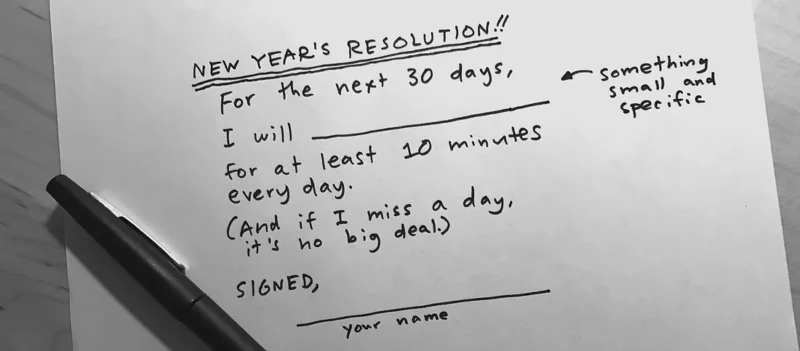
So as we enter 2026, let’s remember to work with our brain’s natural learning system: Frame your goals positively, break them into manageable steps, and celebrate small wins along the way.