The impact of cortisol administration or exposure to stress on extinction processes will be tested in four domains. First, effects of cortisol on stimulus-based fear generalization during extinction will be explored using neuroimaging. Second, effects of a novel method of reactivation (presentation of the UCS) combined with cortisol administration on reconsolidation and fear generalization will be tested. Third, the influence of stress on context-dependent reinstatement will be investigated. Fourth, phase dependent stress effects on extinction of operant behavior will be characterized using appetitive and aversive consequences.
Guiding questions of A09:
Hagedorn B, Wolf OT, Merz CJ (2022) Cortisol before extinction generalization alters its neural correlates during retrieval. Psychoneuroendocrinology 136:105607. https://doi.org/10.1016/j.psyneuen.2021.105607
Hagedorn B, Wolf OT, Merz CJ (2021) Stimulus-Based Extinction Generalization: Neural Correlates and Modulation by Cortisol. Int J Neuropsychopharmacol 24:354–365. https://doi.org/10.1093/ijnp/pyaa085
Jentsch VL, Pötzl L, Wolf OT, Merz CJ (2022) Hormonal contraceptive usage influences stress hormone effects on cognition and emotion. Front Neuroendocrinol. 67: 101012. https://doi.org/10.1016/j.yfrne.2022.101012
Jentsch VL, Wolf OT, Merz CJ (2020) Temporal dynamics of conditioned skin conductance and pupillary responses during fear acquisition and extinction. Int J Psychophysiol 147:93–99. https://doi.org/10.1016/j.ijpsycho.2019.11.006
Jentsch VL, Wolf OT, Otto T, Merz CJ (2023) The impact of physical exercise on the consolidation of fear extinction memories. Psychophysiology 60:e14373.https://doi.org/10.1111/psyp.14373
Kinner VL, Wolf OT, Merz CJ (2018) Cortisol increases the return of fear by strengthening amygdala signaling in men. Psychoneuroendocrinology 91:79–85. https://doi.org/10.1016/j.psyneuen.2018.02.020
Meir Drexler S, Merz CJ, Jentsch VL, Wolf OT (2019) How stress and glucocorticoids timing-dependently affect extinction and relapse. Neurosci Biobehav Rev 98:145–153. https://doi.org/10.1016/j.neubiorev.2018.12.029
Merz CJ, Wolf OT (2022) How stress hormones shape memories of fear and anxiety in humans. Neurosci Biobehav Rev 142:104901. https://doi.org/10.1016/j.neubiorev.2022.104901
Raeder F, Merz CJ, Tegenthoff M, Dere E, Wolf OT, Margraf J, Schneider S, Zlomuzica A (2023) Do oral contraceptives modulate the effects of stress induction on one-session exposure efficacy and generalization in women? Psychopharmacology (Berl) 240:1075–1089.https://doi.org/10.1007/s00213-023-06345-3
Schmidt K, Schlitt F, Wiech K, Merz CJ, Kleine-Borgmann J, Wolf OT, Engler H, Forkmann K, Elsenbruch S, Bingel U (2024) Hydrocortisone Differentially Affects Reinstatement of Pain-related Responses in Patients With Chronic Back Pain and Healthy Volunteers. J Pain 25:1082–1093.https://doi.org/10.1016/j.jpain.2023.10.028

As the calendar turns to a new year, millions of people around the world commit to New Year’s resolutions, making promises to use the new year as a fresh beginning and an opportunity for transformation. In 2024, almost three-quarters of the British population set themselves New Year’s resolutions — that’s around 40 million people (or the entire population of Canada). This tradition was particularly strong among younger generations, with 96% of Generation Z (aged 18-27) planning resolutions, compared to just 35% of the Silent Generation (aged 79+).
Most common new years resolutions:
How long do most resolutions normally last before being broken?
What makes resolutions stick?
Oscarsson et al. (2020) conducted research into what makes New Year’s resolutions stick. Biggest success rates depended on how people phrased their goals. Participants who set approach-oriented goals (trying to move toward or maintain a desirable outcome or state) than those with avoidance-oriented goals (trying to move toward or maintain a desirable outcome or state) were significantly more successful (58.9% vs. 47.1%) at sticking to their goals.
The study also investigates the effects of outside support. These participants received monthly follow-ups and emails with information and exercises for coping with hurdles when striving toward personal goals, and were also encouraged to set goals using the SMART technique and to set interim goals. The group that received some support was exclusively and significantly more successful compared to the groups who received a lot of support or no support at all.
Additionally, you might feel more successful if you set goals that are measurable in numbers. While success for a person striving to quit smoking or lose weight could easily be measured in the number of cigarettes smoked or body mass index, the success for a person striving to “take better care of themselves” could be highly subjective and possibly impossible to measure.
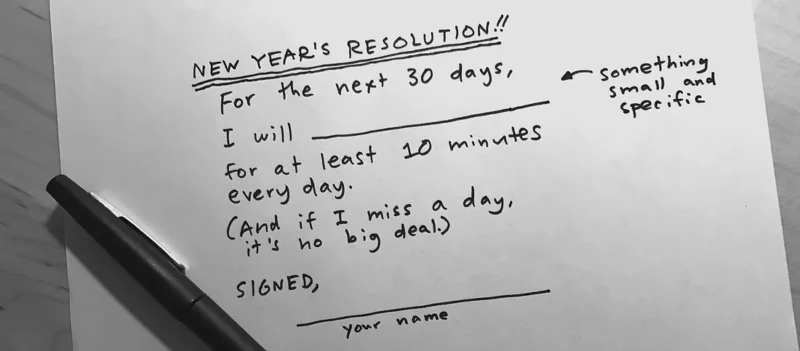
So as we enter 2026, let’s remember to work with our brain’s natural learning system: Frame your goals positively, break them into manageable steps, and celebrate small wins along the way.