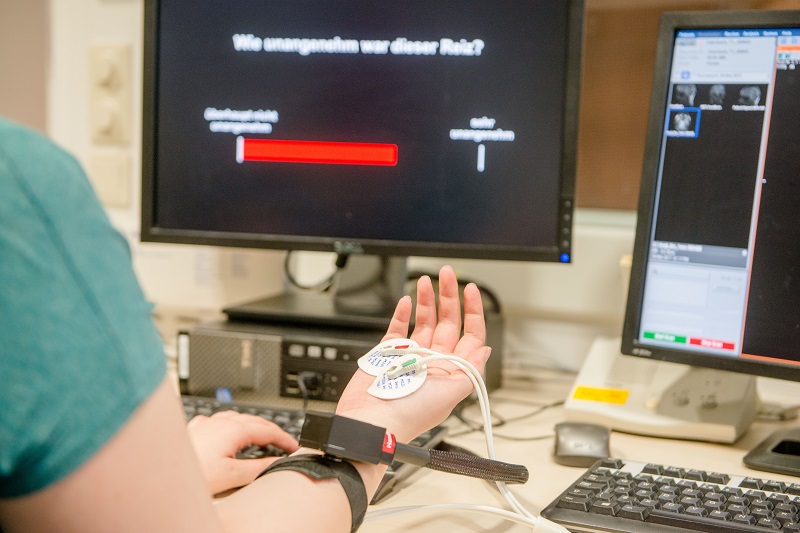
Project A11 will investigate neural and behavioral mechanisms underlying the acquisition, extinction and reinstatement of pain-related fear in the context of somatic pain. We will compare patients suffering from chronic low back pain to healthy controls using a differential fear conditioning paradigm with painful heat as unconditioned stimuli (US) while collecting behavioral, physiological, neuroendocrine and neural data (MRI). The planned studies will examine (1) pain-specific aspects of fear conditioning, (2) the effects of pharmacologically induced stress on extinction recall and reinstatement and (3) neural common and distinct neural mechanisms underlying appetitive and aversive conditioning in the context of somatic pain.
Guiding questions of A11:
Busch L, Wiech K, Gamer M, Kincses B, Spisák T, Schmidt K*, Bingel U* (2023) Modulatory effects of instructions on extinction efficacy in appetitive and aversive learning: A registered report.https://osf.io/cj75p
Forkmann K, Wiech K, Schmidt K, Schmid-Köhler J, Bingel U (2023) Neural underpinnings of preferential pain learning and the modulatory role of fear. Cerebral Cortex 33:9664–9676. https://doi.org/10.1093/cercor/bhad236
Kincses B, Forkmann K, Schlitt F, Jan Pawlik R, Schmidt K, Timmann D, Elsenbruch S, Wiech K, Bingel U, Spisák T (2024) An externally validated resting-state brain connectivity signature of pain-related learning. Commun Biol 7:875. https://doi.org/10.1038/s42003-024-06574-y
Koenen LR, Icenhour A, Forkmann K, Theysohn N, Forsting M, Bingel U, Elsenbruch S (2018) From Anticipation to the Experience of Pain: The Importance of Visceral Versus Somatic Pain Modality in Neural and Behavioral Responses to Pain-Predictive Cues. Psychosomatic Medicine 80:826–835. https://doi.org/10.1097/PSY.0000000000000612
Koenen LR, Pawlik RJ, Icenhour A, Petrakova L, Forkmann K, Theysohn N, Engler H, Elsenbruch S (2021) Associative learning and extinction of conditioned threat predictors across sensory modalities. Commun Biol 4:553. https://doi.org/10.1038/s42003-021-02008-1
Li J*, Schmidt K*, Busch L, Forkmann K, Spisák T, Kaur J, Schlitt-Nguyen F, Wiech K, Bingel U (2025) Common and distinct neural mechanisms of aversive and appetitive pain-related learning. bioRxiv:2025.04.02.646781. https://doi.org/10.1101/2025.04.02.646781 #OA
Schlitt F, Schmidt K, Merz CJ, Wolf OT, Kleine-Borgmann J, Elsenbruch S, Wiech K, Forkmann K, Bingel U (2022) Impaired pain-related threat and safety learning in patients with chronic back pain. Pain 163:1560–1570. https://doi.org/10.1097/j.pain.0000000000002544
Schmidt K, Forkmann K, Elsenbruch S, Bingel U (2020) Enhanced pain-related conditioning for face compared to hand pain. PLoS ONE 15:e0234160. https://doi.org/10.1371/journal.pone.0234160
Schmidt K*, Schlitt F*, Wiech K, Merz CJ, Kleine-Borgmann J, Wolf OT, Engler H, Forkmann K, Elsenbruch S*, Bingel U* (2024) Hydrocortisone Differentially Affects Reinstatement of Pain-related Responses in Patients With Chronic Back Pain and Healthy Volunteers. The Journal of Pain 25:1082–1093. doi: 10.1016/j.jpain.2023.10.028
van der Schaaf ME*, Schmidt K*, Kaur J, Gamer M, Wiech K, Forkmann K, Bingel U (2022) Acquisition learning is stronger for aversive than appetitive events. Commun Biol 5:302. https://doi.org/10.1038/s42003-022-03234-x

As the calendar turns to a new year, millions of people around the world commit to New Year’s resolutions, making promises to use the new year as a fresh beginning and an opportunity for transformation. In 2024, almost three-quarters of the British population set themselves New Year’s resolutions — that’s around 40 million people (or the entire population of Canada). This tradition was particularly strong among younger generations, with 96% of Generation Z (aged 18-27) planning resolutions, compared to just 35% of the Silent Generation (aged 79+).
Most common new years resolutions:
How long do most resolutions normally last before being broken?
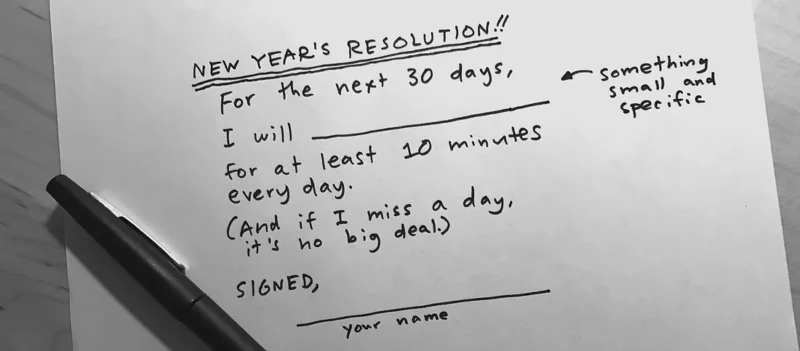
What makes resolutions stick?
Oscarsson et al. (2020) conducted research into what makes New Year’s resolutions stick. Biggest success rates depended on how people phrased their goals. Participants who set approach-oriented goals (trying to move toward or maintain a desirable outcome or state) than those with avoidance-oriented goals (trying to move toward or maintain a desirable outcome or state) were significantly more successful (58.9% vs. 47.1%) at sticking to their goals.
The study also investigates the effects of outside support. These participants received monthly follow-ups and emails with information and exercises for coping with hurdles when striving toward personal goals, and were also encouraged to set goals using the SMART technique and to set interim goals. The group that received some support was exclusively and significantly more successful compared to the groups who received a lot of support or no support at all.
Additionally, you might feel more successful if you set goals that are measurable in numbers. While success for a person striving to quit smoking or lose weight could easily be measured in the number of cigarettes smoked or body mass index, the success for a person striving to “take better care of themselves” could be highly subjective and possibly impossible to measure.
So as we enter 2026, let’s remember to work with our brain’s natural learning system: Frame your goals positively, break them into manageable steps, and celebrate small wins along the way.