Cooperation with other Collaborative Research Centers, institutions and also individual scientists means exchange, new ideas and opportunities. We thank our partners for their fresh perspectives and excellent expertise. Our partners include:
Berlin-Bochum Memory Alliance
The Berlin-Bochum Memory Alliance is a transregional collaborative initiative of four DFG-funded consortia. Its goal is to create synergies across consortia, by providing a platform for members to share ongoing memory research and to network. To this end, the alliance hosts joint events and supports self-organized initiatives by its early-career researchers. Find out more @ memory-alliance.deor click on the interactive logos.
Aims of the Alliance
Global Strengthen memory research in Germany
Specific Discover new opportunities to collaborate and create joint projects
Specific
Support early career researchers and building a young scientist network
Specific
Share results and engaging in outreach
Fellows
Exchanging ideas with colleagues nationally and internationally is an important part of proper scientific conduct. Therefore we are happy to greet our regular guests at the SFB 1280, who in turn contribute with their expertise in specific projects and as advisors to the SFB as a whole. Fellows are integrated to a greater extent than visiting researchers. They are associated with the project over the long term and at least partially on site at the host institution. They remain in contact with the project network even after their stay.
Annemie van der Linden, University of Antwerp – Animal Imaging
Annemie van der Linden is one of the leading experts in the field of Animal MR. She will accompany the experiments in both A01 and A04, and support planned pilots in A07, A12, A18, A19, and A21. With her support we can realize our long-term plan to teach animal MR to projects that aren’t conducting MR yet. For this purpose, Annemie van der Linden will provide hands-on animal MR-courses at the University of Antwerp for our PhD students and postdocs. Annemie van der Linden will also be often in Bochum to help us to develop more advanced experimental imaging procedures. Taken together, this cooperation should importantly enhance our vison of Animal MR on two levels: First, Training young people in MR-compatible experiments and procedures as an extremely fast growing and important scientific technology with high relevance for the SFB. Second, Establishing the collaboration between Bochum and Antwerp.
Harald Lachnit, Philipps-Universität Marburg – Learning Dynamics and the concept of extinction
Harald Lachnit is one of the most renowned researchers on learning and behavior. He contributed strongly to the birth idea of this research group and since the transformation of the Research Unit 1581 into the SFB 1280, he again had a formative function in the design of the learning theory foundation. For private reasons, he retired from active duty on March 31, 2021, contrary to earlier plans, and will no longer be available to the SFB 1280 in the second funding period. It is therefore extremely gratifying that he has agreed to continue advising the SFB as a Fellow. Against the background of 15 years of intensive cooperation in both joint projects, he is an ideal and invaluable advisor in the field of associative learning and thus an asset for the SFB and its individual projects.
The entire issue as PDF here
The SFB 1280 has also appeared in other RUB editorial series, including
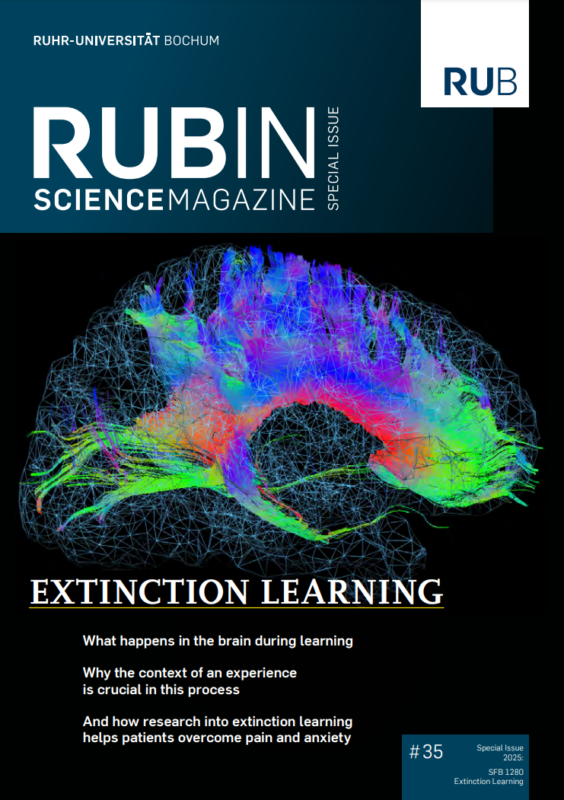
RUBIN, the RUB’s science magazine, together with the SFB 1280, is publishing a new issue for anyone interested in forgetting in January 2025 – RUBIN Extinction Learning 2025. All articles printed in it will appear online in advance on the RUB news portal. We are very pleased to have this opportunity to present our research in a collected and condensed form.