
A01 A02 A04 A05 A07 A09 A10 A11 A12 A13 A14 A18 A19 A21 F01 F02 INF Ö

Can You Forget? – A Mini-Museum for Learning, Forgetting, and Remembering at the University Library of Ruhr University Bochum

25. November 2026

Learning is difficult. And forgetting sometimes even more so. Since 2017, the Collaborative Research Center 1280 “Extinction Learning” has devoted its full attention to learning, unlearning, and relearning. And it is now dedicating a special traveling exhibition to these topics, designed for visitors to explore on their own.

Starting November 23, 2026, the mini-museum will be on display at the University Library of Ruhr University Bochum.

The Mini-Museum on Extinction Learning offers insights into the memory of humans, animals, and machines. In about 15 minutes, the exhibition shows what happens in the brain during unlearning and relearning, how memory is actually studied, what stress and anxiety have to do with our memories, and what it actually sounds like when neurons process signals. Anyone who would like to stay longer is, of course, welcome to do so.

The mini-museum is located on the first floor of the university library, ready for you to explore on your own.

At the same time, just a few meters away, the exhibition for the long-standing student art competition organized by the International Graduate School of Neuroscience (IGSN) is taking place. This year’s theme was “A Fit Brain: What Keeps You on Your Toes?”

We look forward to seeing you there!

Exhibition dates: November 23 – December 14, 2026
Location:
University Library of Ruhr University Bochum
1st floor/Central Staircase

Hours:
Monday – Friday: 8 a.m. to 11 p.m.
Saturday & Sunday: 10 a.m. to 7 p.m.

For more information, visit: https://www.ub.ruhr-uni-bochum.de/en/courses-and-events/events/archive/2026/our-brain-in-focus

```
SFB 1280 Extinction Learning Contact Universities
DFG Funding Programme
Moodle Internal
Legal Notice
Privacy Policy
Map
```

New Year, New Me: The Facts

As the calendar turns to a new year, millions of people around the world commit to New Year’s resolutions, making promises to use the new year as a fresh beginning and an opportunity for transformation. In 2024, almost three-quarters of the British population set themselves New Year’s resolutions — that’s around 40 million people (or the entire population of Canada). This tradition was particularly strong among younger generations, with 96% of Generation Z (aged 18-27) planning resolutions, compared to just 35% of the Silent Generation (aged 79+).

Most common new years resolutions:

  1. Saving more money (52%)
  2. Eat healthier (50%)
  3. Exercise more (48%)
  4. Lose weight (37%)
  5. Spend more time with family/friends (35%)

How long do most resolutions normally last before being broken?

  • Data from America (2016) shows that 75% of individuals maintain their resolutions through the first week. 
  • 64% of individuals maintain their resolutions through the first month. 
  • 46% of individuals in America keep their resolutions past the 6-month mark.

What makes resolutions stick?

Oscarsson et al. (2020) conducted research into what makes New Year’s resolutions stick. Biggest success rates depended on how people phrased their goals. Participants who set approach-oriented goals (trying to move toward or maintain a desirable outcome or state) than those with avoidance-oriented goals (trying to move toward or maintain a desirable outcome or state) were significantly more successful (58.9% vs. 47.1%) at sticking to their goals.

The study also investigates the effects of outside support. These participants received monthly follow-ups and emails with information and exercises for coping with hurdles when striving toward personal goals, and were also encouraged to set goals using the SMART technique and to set interim goals. The group that received some support was exclusively and significantly more successful compared to the groups who received a lot of support or no support at all. 

Additionally, you might feel more successful if you set goals that are measurable in numbers. While success for a person striving to quit smoking or lose weight could easily be measured in the number of cigarettes smoked or body mass index, the success for a person striving to “take better care of themselves” could be highly subjective and possibly impossible to measure.

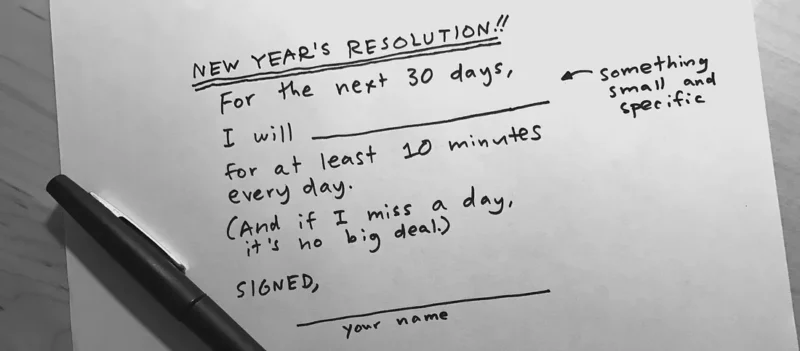
So as we enter 2026, let’s remember to work with our brain’s natural learning system: Frame your goals positively, break them into manageable steps, and celebrate small wins along the way.