
A01 A02 A04 A05 A07 A09 A10 A11 A12 A13 A14 A18 A19 A21 F01 F02 INF Ö

A Translational Perspective on Extinction Learning at the 54th DGPs Congress

4. September 2026

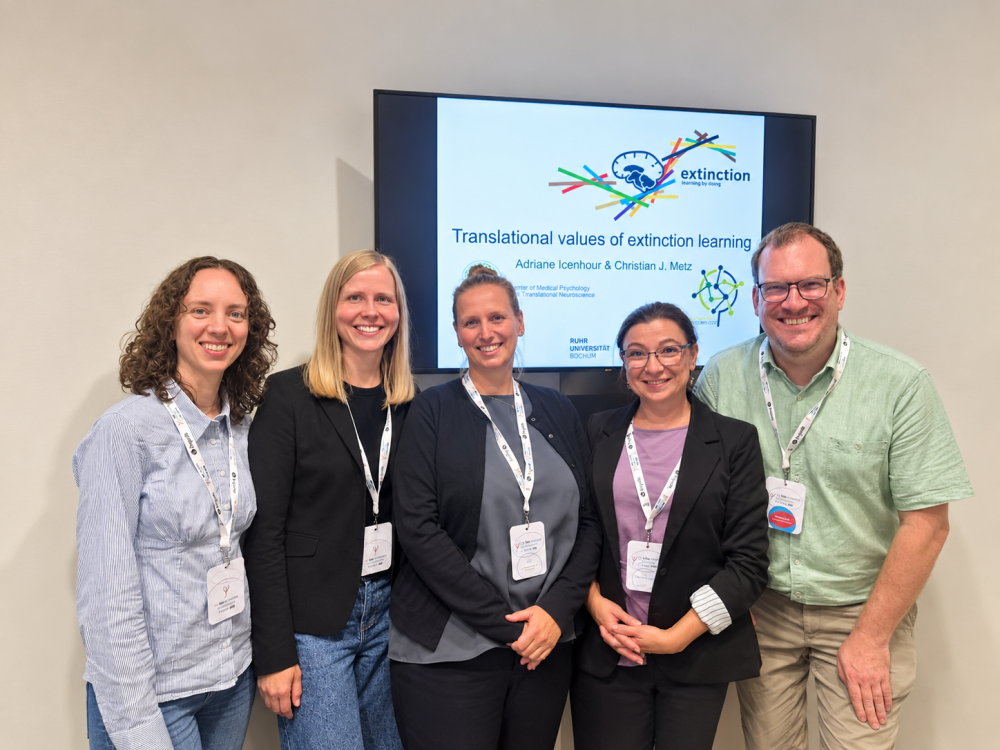
At the 54th DGPs Congress in Luxembourg, a symposium led by Prof. Dr. Christian Merz (project lead A09) and Prof. Dr. Adriane Icenhour (project lead A10) will explore how findings on extinction learning can be translated into clinical practice. The focus will be on the role of stress, cognition, and interoception in the development and maintenance of anxiety and pain disorders, as well as potential approaches to improving exposure therapies.

In five presentations, researchers will examine, among other topics, the influence of stress hormones on extinction memories, the significance of cognitive factors in anxiety disorders, and mechanisms of pain-related and visceral anxiety learning. In addition, the symposium will examine how acute and chronic inflammatory processes influence learning and memory processes and can thereby contribute to the maintenance of pain.

The symposium thus highlights the close connection between basic research and clinical application: A better understanding of extinction learning is intended to help develop new therapeutic strategies for patients with anxiety disorders as well as somatic and visceral pain conditions. The long-standing connection to the DGPs is also evident: Prof. Dr. Onur Güntürkün (project lead A01, F01, Z, Ö) served as congress coordinator of the DGPs’ 2014 conference, which was held in Bochum that year.

The DGP Congress will take place in Luxembourg from September 7 to 10, 2026; the symposium is scheduled for September 7 at 4:30 p.m
```
SFB 1280 Extinction Learning Contact Universities
DFG Funding Programme
Moodle Internal
Legal Notice
Privacy Policy
Map
```

New Year, New Me: The Facts

As the calendar turns to a new year, millions of people around the world commit to New Year’s resolutions, making promises to use the new year as a fresh beginning and an opportunity for transformation. In 2024, almost three-quarters of the British population set themselves New Year’s resolutions — that’s around 40 million people (or the entire population of Canada). This tradition was particularly strong among younger generations, with 96% of Generation Z (aged 18-27) planning resolutions, compared to just 35% of the Silent Generation (aged 79+).

Most common new years resolutions:

  1. Saving more money (52%)
  2. Eat healthier (50%)
  3. Exercise more (48%)
  4. Lose weight (37%)
  5. Spend more time with family/friends (35%)

How long do most resolutions normally last before being broken?

  • Data from America (2016) shows that 75% of individuals maintain their resolutions through the first week. 
  • 64% of individuals maintain their resolutions through the first month. 
  • 46% of individuals in America keep their resolutions past the 6-month mark.

What makes resolutions stick?

Oscarsson et al. (2020) conducted research into what makes New Year’s resolutions stick. Biggest success rates depended on how people phrased their goals. Participants who set approach-oriented goals (trying to move toward or maintain a desirable outcome or state) than those with avoidance-oriented goals (trying to move toward or maintain a desirable outcome or state) were significantly more successful (58.9% vs. 47.1%) at sticking to their goals.

The study also investigates the effects of outside support. These participants received monthly follow-ups and emails with information and exercises for coping with hurdles when striving toward personal goals, and were also encouraged to set goals using the SMART technique and to set interim goals. The group that received some support was exclusively and significantly more successful compared to the groups who received a lot of support or no support at all. 

Additionally, you might feel more successful if you set goals that are measurable in numbers. While success for a person striving to quit smoking or lose weight could easily be measured in the number of cigarettes smoked or body mass index, the success for a person striving to “take better care of themselves” could be highly subjective and possibly impossible to measure.

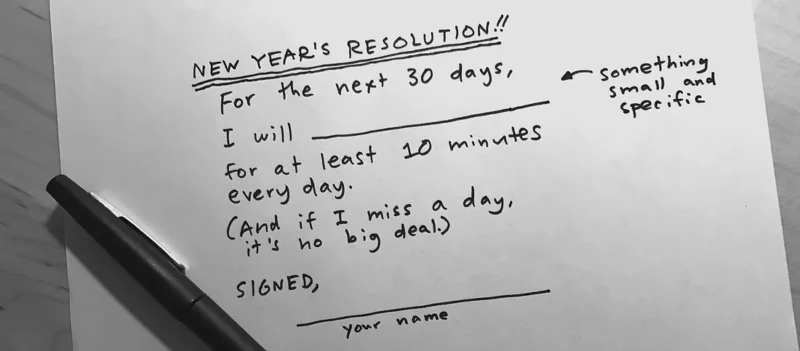
So as we enter 2026, let’s remember to work with our brain’s natural learning system: Frame your goals positively, break them into manageable steps, and celebrate small wins along the way.