
A01 A02 A03 A04 A05 A06 A07 A09 A10 A11 A12 A13 A14 A18 A19 A21 F01 F02 INF Ö

Treasure Chest Funding for Harleen Chhabra (A06): Reliability of Voxel Placement Methods for Magnetic Resonance Spectroscopy

Magnetic resonance spectroscopy (MRS) is a non-invasive brain imaging technique that plays an important role in understanding the role of metabolites and neurotransmitters in cognition and clinical conditions. Unlike functional imaging, obtaining MRS data requires first selecting a region specific to the study, which can then be identified on the anatomical images of the brain. In her project “Reliability of Voxel Placement Methods for Magnetic Resonance Spectroscopy”, Harleen Chhabra (A06) wants to find out more about how these regions can be selected precisely and specifically. She describes the project as follows:

Single-voxel magnetic resonance spectroscopy (MRS) is a non-invasive technique that measures cognitively and clinically relevant metabolites and neurotransmitters. Unlike magnetic resonance imaging, MRS needs an a priori region definition for data acquisition and single voxel spectroscopy provides high-quality spectra. Therefore, precise selection of the MRS voxel is crucial to ensure accurate and reliable results across multiple study sessions and participants. In the current study, we will use three methods for voxel placement, the conventional anatomy landmark-based method, the functionally localized region method, and individualised atlas-based brain parcellation method. The regions of interest will be the ventromedial prefrontal cortex (relevant for fear extinction studies) and the parietal cortex as a control region. γ-aminobutyric acid (GABA) and glutamine/glutamate (Glx) spectra during the resting state will be collected from the healthy volunteers. Spectra data will be collected twice for test-retest accuracy and reliability. The spatial overlap of the MRS voxels within the participants across the multiple sessions, between the three voxel placement methods, and between the participants will be examined. Additionally, spectral analysis will be done to report the results of data quality. The result will inform about the best method for voxel placement within the ventromedial prefrontal and parietal cortex and will guide future MRS studies in choosing the appropriate methodology to report accurate and reliable results.

The SFB 1280 has set up a budget for its young scientists to realize their own research ideas. We use the “treasure chest” to finance convincing and independent study concepts of our early career researchers.
New Year, New Me: The Facts

As the calendar turns to a new year, millions of people around the world commit to New Year’s resolutions, making promises to use the new year as a fresh beginning and an opportunity for transformation. In 2024, almost three-quarters of the British population set themselves New Year’s resolutions — that’s around 40 million people (or the entire population of Canada). This tradition was particularly strong among younger generations, with 96% of Generation Z (aged 18-27) planning resolutions, compared to just 35% of the Silent Generation (aged 79+).

Most common new years resolutions:

  1. Saving more money (52%)
  2. Eat healthier (50%)
  3. Exercise more (48%)
  4. Lose weight (37%)
  5. Spend more time with family/friends (35%)

How long do most resolutions normally last before being broken?

  • Data from America (2016) shows that 75% of individuals maintain their resolutions through the first week. 
  • 64% of individuals maintain their resolutions through the first month. 
  • 46% of individuals in America keep their resolutions past the 6-month mark.

What makes resolutions stick?

Oscarsson et al. (2020) conducted research into what makes New Year’s resolutions stick. Biggest success rates depended on how people phrased their goals. Participants who set approach-oriented goals (trying to move toward or maintain a desirable outcome or state) than those with avoidance-oriented goals (trying to move toward or maintain a desirable outcome or state) were significantly more successful (58.9% vs. 47.1%) at sticking to their goals.

The study also investigates the effects of outside support. These participants received monthly follow-ups and emails with information and exercises for coping with hurdles when striving toward personal goals, and were also encouraged to set goals using the SMART technique and to set interim goals. The group that received some support was exclusively and significantly more successful compared to the groups who received a lot of support or no support at all. 

Additionally, you might feel more successful if you set goals that are measurable in numbers. While success for a person striving to quit smoking or lose weight could easily be measured in the number of cigarettes smoked or body mass index, the success for a person striving to “take better care of themselves” could be highly subjective and possibly impossible to measure.

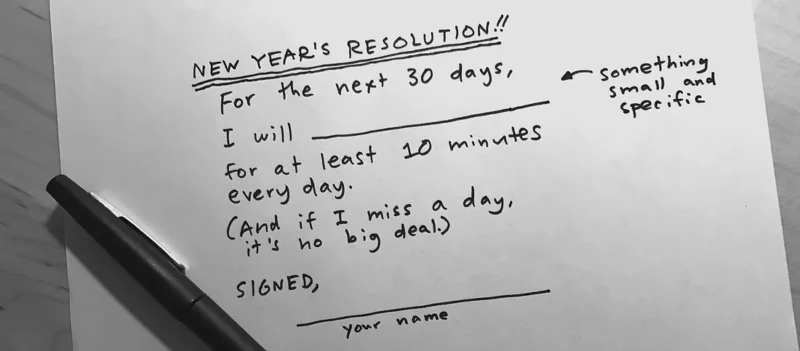
So as we enter 2026, let’s remember to work with our brain’s natural learning system: Frame your goals positively, break them into manageable steps, and celebrate small wins along the way.