A doctorate crowns years of intensive research into a topic and is proof of expertise in sometimes highly specialized areas of a subject. However, the job market is looking for all-round candidates who can present, raise and manage funds, are team players, have taken on their first management tasks and are networked around the world. The complete package is guaranteed by attending our Research Training Groups. They offer structured doctoral training with the aim of intensively preparing doctoral students for the complex and interdisciplinary job market of “science” and supporting their academic independence.
In order to provide doctoral students with a meaningful offer across the broad spectrum of our disciplines, we cooperate with the IGSN as a renowned neuroscience hub, the BIOME as a college for the field of medicine, which has also had a dedicated focus on neuroscience since the beginning of the SFB, as well as with the IGB and RUB Research School. In this way, we guarantee that our doctoral students receive a broad-based education that optimally prepares them for a career in science.
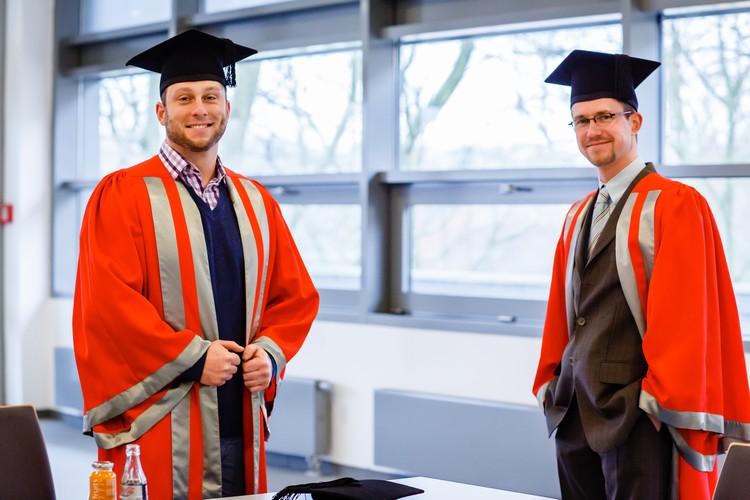
Celebration at the IGSN „Graduate Day“
IGSN – International Graduate School of Neuroscience
The International Graduate School of Neuroscience has been training a new generation of young neuroscientists every year since 2001.
The program teaches the full spectrum of neuroscience, from its molecular basis to higher cognitive functions, in English. The interdisciplinary character of the IGSN is fed by the four faculties of Biology, Chemistry, Medicine and Psychology and the Institute for Neural Computation.
In order to be able to compete in the international field later on, students learn according to a transdisciplinary and multidisciplinary educational approach. In an individualized, focused program, accelerated doctoral training is made possible, leading to the title “Doctor of Neuroscience” within 36 months. In addition to the students’ own research work, the academic program includes a detailed curriculum combined with soft skills training.
The curriculum of the six semesters includes a 14-week lecture series “From Molecules to Cognition”, the organization of colloquia and symposia, laboratory rotations, practical and methodological courses, seminars, journal clubs and personality training (e.g. presentation, rhetoric and management skills).
BIOME – Graduate School of Biomedical Science. Core: Behavioural and Clinical Neuroscience
Behavioral and Clinical Neuroscience is the title of a course created in 2017 in parallel with the establishment of the CRC. It is specifically tailored to doctoral students at the University Hospital in Essen who are pursuing a career in the field of neuroscience. A selection of fortnightly lecture series and colloquia are held by specialists from the Faculty of Medicine and guest scientists. The events provide a broad overview of fundamental translational and clinical aspects of neuroscience. Following the lectures, PhD / MD students present and discuss their own results in a graduate seminar.
The doctoral program focuses on the scientific principles of modern neuroscience in clinical practice. In addition to teaching theory, BIOME places great emphasis in its curriculum on showing the application horizons in neurological and neuropsychiatric diseases. To this end, current research projects from the faculty are presented, and regular meet-the-expert forums and annual retreats add to this experience.
The Graduate School of Biomedical Science (BIOME) of physicians and biologists at the University of Duisburg-Essen has been offering a focus on behavioral and clinical neuroscience since 2016.
IGB – Internationale Graduiertenschule Biowissenschaften
The Faculty of Biology and Biotechnology established an International Graduate School of Biosciences (IGB) back in 2004. This created the basis for structured doctoral training and standardized doctoral procedures in the biosciences.
By bringing together bioscientific working groups from the Faculty of Biology and Biotechnology, the Faculty of Chemistry and Biochemistry, the Faculty of Medicine and several other groups, the IGB currently offers an excellent research environment for around 200 doctoral students.
RUB Research School
The RUB Research School is a university-wide, interdisciplinary graduate school that offers excellent funding opportunities, soft-skill courses that cleverly complement the usual offerings and now also a postdoctoral program. The Research School supports doctoral candidates and early career researchers in developing their individual skills and exchanging ideas across disciplines.