Family friendliness
The job of being a scientist has many wonderful facets
A permanent position, fixed working hours and a 40 hour week
unfortunately are usually not part of it
What to do when work and family obligations collide? Together with mothers and fathers in the collaborations the SFB 1280 is working to improve the situation locally and to identify structural programs to create more freedom for personal development. At the same time, you may have to look at caring for relatives which must be manageable alongside work. In the collaborations of SFB 1280 they have established some tools to be able to combine science and family better. At the same time the board for equal opportunity is constantly looking for new or individual solutions. It is aided by the management, which is involved in equality and monitors the distribution of resources according to equal opportunities:
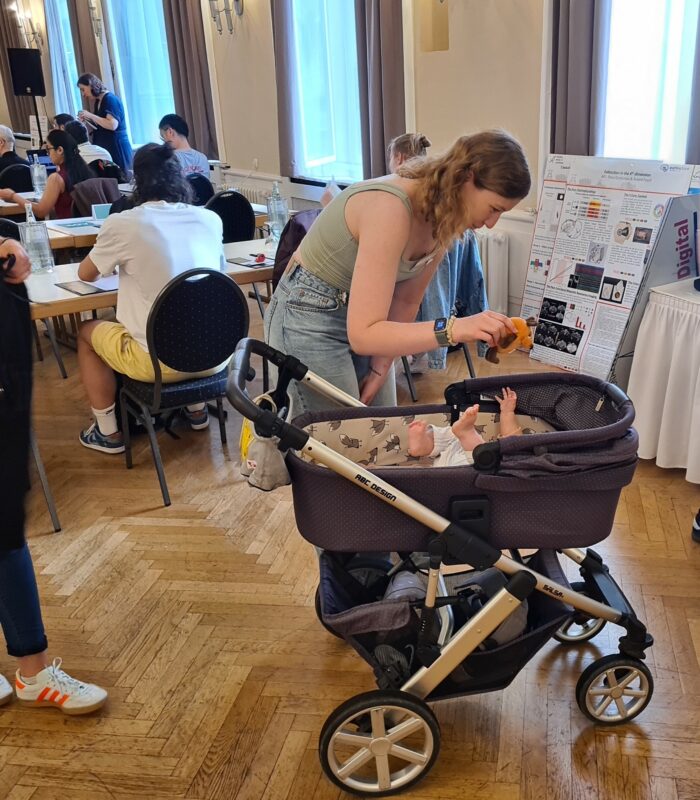
- Childcare or that of a relative which is in need of care can be financed for times after regular care ends. This makes it possible to take part in SFB relevant events, such as meeting or conferences, or being able to access equipment and perform experiments in the evenings. Of course, the administration tries to schedule everything family friendly.
- During parental leave of a project leading person a qualified replacement personnel can at least partially be financed. In the SFB 1280 it is no problem to individually schedule working hours.
- The SFB 1280 supports the family friendly organisation of working hours by supporting home offices or offices suitable for children.
- While traveling to important conferences, the Sonderforschungsbereich can potentially cover the costs for a toddler to accompany you.
- During parental leave all members still have the opportunity to take part in mentoring or training programs. Together with the administration of the SFB the parent can brainstorm for solutions on how keep in contact and come back.
- Financing of a student assistant to help parents and caregivers with project related routines in the lab.
Mobile kids room
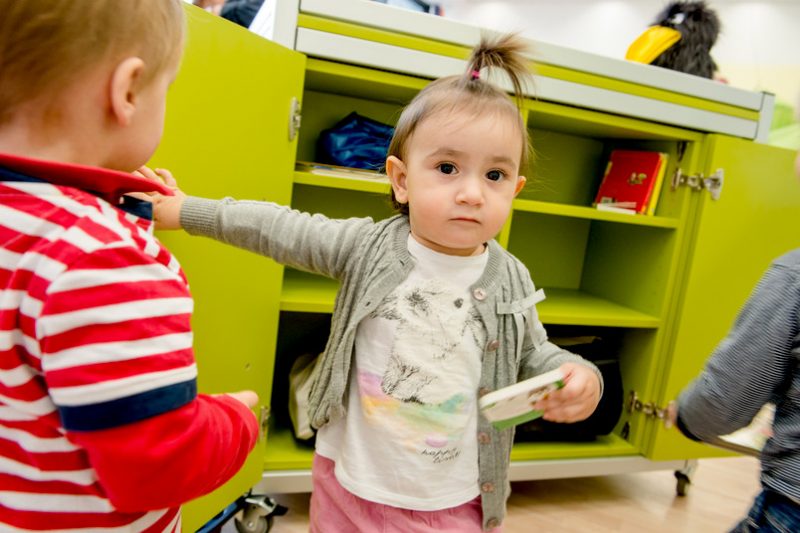
It can come as a surprise: the kindergarden is sick, grandma is on strike, there’s a lot of reasons why the little one sometimes have to come to the office. So that this does not turn into a stressful adventure for child and parents, the SFB 1280 has worked together with the craftsmen of the workshop in the faculty for psychology in Bochum and the representative of “Familiengerechte Hochschule” of the RUB to get this idea rolling: the mobile kids room, a small cupboard on wheels, which contains not folders, but everything a child needs for a day at the office.
Toy wouldn’t hurt, some crayons to keep the child busy and also a bottle warmer and a travel bed. All of this doesn’t just lie around in the office, but can be found in the mobile kids room: young children will always find something in there that make their eyes sparkle and time fly. Puzzles, building blocks, books, paper, pens, games and so on. This little helper is also a great addition for events.
Borrowing it is very simple. You can find it in the room GAFO 03/957 and it doesn’t matter whether you need the entire thing or just a few parts, the SFB secretaries’ office next door will always lend a helping hand with the transport. At Uniklinik in Essen, the mobile kids room can be found in LLZ room 47.0.020. At IfADo, the rolling helper is located at the reception.